GMAT Exam Pattern 2026: Latest Test Structure, Sections & Marking Scheme
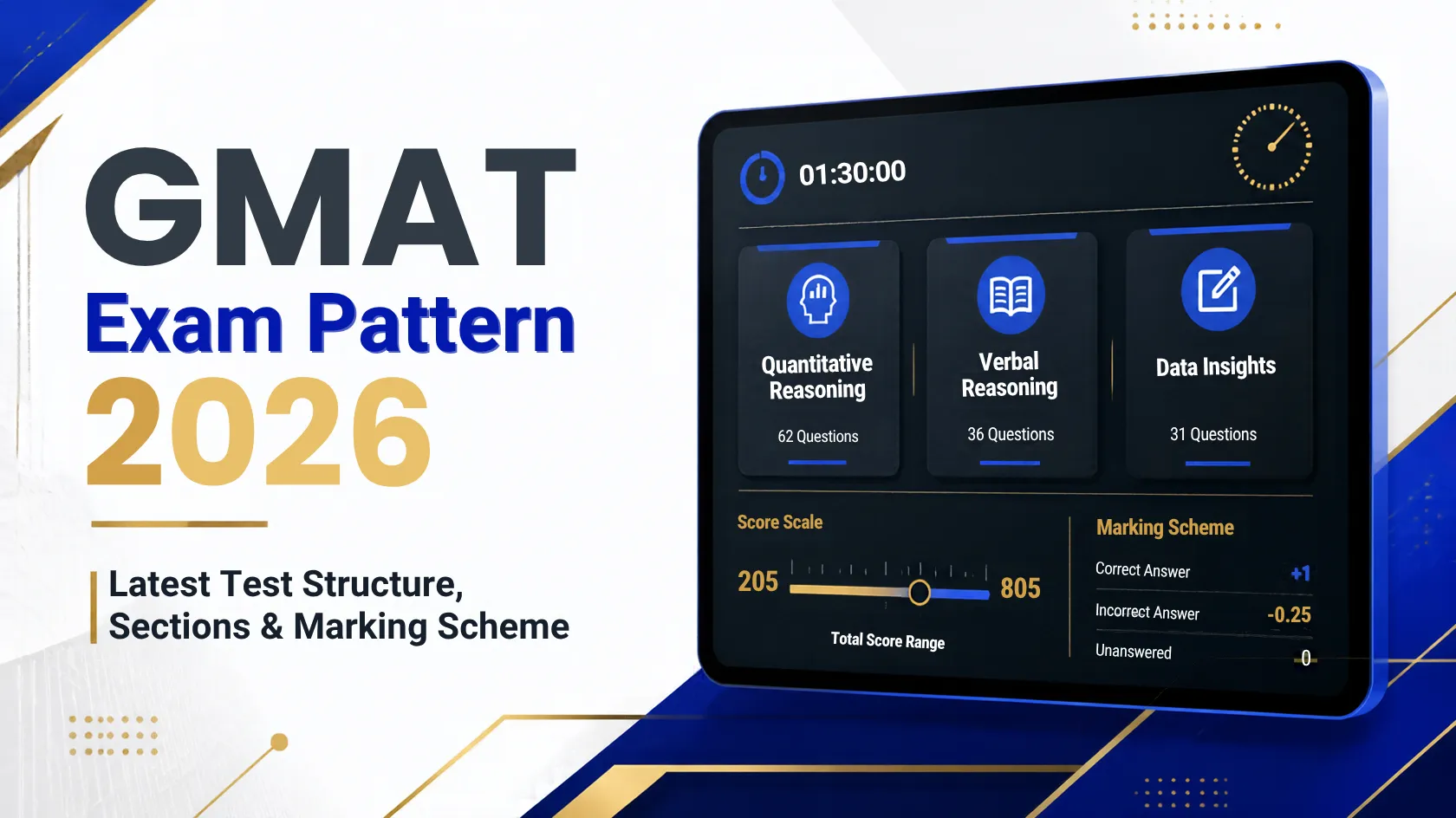
Starting your MBA journey? Then the GMAT is probably on your list. Before you start any of the prep books, knowing what you’re going to be facing will help.
Knowing about the GMAT Exam Pattern 2026 will tell you how many sections there are, how long you’ll have to complete them, what types of questions there will be, and how you’ll be scored. Knowing this means you can tailor your revision, choose the correct materials to use, and go into the test centre (or your home setup) without any surprises.
This article will explain the new GMAT pattern in simple terms and compare it to the old GMAT. We also give some useful tips to help you prepare for it.
The GMAT rules can be changed at any time by the GMAC (Graduate Management Admission Council). Always check the official mba.com site for the most up-to-date information when you are registering.
GMAT Exam Pattern: An Overview
- Below is the quick overview of the GMAT.
- 3 sections (Quantitative Reasoning, Verbal Reasoning, Data Insights)
- Total questions: 64
- Total duration: 2 hours 15 minutes, plus one optional 10-minute break
- Time per section: 45 minutes each
- Question format: Multiple choice (including a few multi-part formats in Data Insights)
- Section order: You choose the order
- Review & Edit: Bookmark questions and change up to 3 answers per section
- Total score range: 205–805
- Section score range: 60–90
- Essay (Analytical Writing): Not part of the current exam
GMAT Exam Pattern: Summary Table
| Feature | Details |
|---|---|
| Number of sections | 3 |
| Total questions | 64 |
| Exam duration | 2 hours 15 minutes (plus optional 10-minute break) |
| Section timing | 45 minutes per section |
| Section order | Choose from available orders |
| Review & Edit | Bookmark and review; change up to 3 answers per section |
| Section score | 60–90 |
| Total score | 205–805 |
| Score weightage | All 3 sections count equally |
| Essay section | No |
GMAT Exam Structure 2026: What Is the Current Format?
The test is newly designed, and in a shorter format. It was launched at the end of 2023, so from February 2024 it is the only version available. However, you might come across references to it as the 'GMAT Focus Edition '. The name "Focus Edition" was added to separate the new exam from the classic one, and today it simply refers to the current GMAT.
The idea behind the change was simple: make the exam shorter, cut content that business schools value less, and give test takers more control.
The exam is also computer-adaptive. That means the difficulty of the questions you see adjusts based on how you perform as you move through each section.
GMAT Exam Sections at a Glance
The GMAT exam has three sections, and each one gets the same 45 minutes.
| Section | Number of Questions | Time Limit | Question Format |
|---|---|---|---|
| Quantitative Reasoning | 21 | 45 minutes | Problem Solving (multiple choice) |
| Verbal Reasoning | 23 | 45 minutes | Reading Comprehension, Critical Reasoning (multiple choice) |
| Data Insights | 20 | 45 minutes | Data Sufficiency, Table Analysis, Graphics Interpretation, Two-Part Analysis, Multi-Source Reasoning |
| Total | 64 | 2 hours 15 minutes | — |
Quantitative Reasoning
This section tests how well you handle numbers and logic. You will solve problems based on arithmetic and algebra. Data Sufficiency questions, which used to sit here, have moved to Data Insights, and geometry is no longer tested. You will have 21 questions in 45 minutes, that gives you around two minutes for each question.
Verbal Reasoning
It measures your comprehension, analysis, and evaluation of written arguments. This section includes two types of questions: Reading Comprehension and Critical Reasoning. Sentence Correction has been eliminated from the GMAT exam. You get 23 questions in 45 minutes.
Data Insights
Data Insights has replaced the previous Integrated Reasoning section. This section is designed to measure how well you understand and use information provided in various forms, similar to that encountered in a business environment. These sections are Data Sufficiency, Table Analysis, Graphics Interpretation, Two-Part Analysis, and Multi-Source Reasoning. You have to answer 20 questions in 45 minutes.
GMAT Exam Duration
The total GMAT exam duration is 2 hours and 15 minutes. This is the actual testing time across the three sections. You will also have an additional option of a 10-minute break during the examination.
On the day of the examination, make sure to add additional time on top of that. Do not base your plans only on the 2 hours 15 minutes duration.
GMAT Total Questions
GMAT consists of 64 questions, 21 from Quantitative Reasoning section, 23 from Verbal Reasoning and 20 from Data Insights.
GMAT Marking Scheme and Scoring System
However, GMAT scoring is unique compared to a normal test done in school; hence, it is important to know the whole process.
- Section Scores: Each section will be scored from 60 to 90 in intervals of 1 point.
- Overall Score: The overall score ranges from 205 to 805 in intervals of 10 points. Valid total scores end in 5.
- Equal weighting: Equally weighted towards the total are the Quantitative, Verbal and Data Insights scores.
- Validity period: The scores are valid for five years.
- GMAT Superscore: For those who take the test more than once, GMAC automatically computes your Super score based on your best section scores during your valid test attempts.
Because of its adaptive nature, a person’s score is dependent not only on how many questions one answered correctly but also on the difficulty level of these questions. This is the reason one can’t just use correct answers to estimate his/her score. Your section scores are not added together directly either.
On the official side, there is no public "marks per question" chart, so be careful with websites that claim one. Note on older scores: If a business school still reports averages on the old 200–800 scale, use GMAC's official score concordance table on mba.com to compare.
Section Order, Question Navigation and Review & Edit
The most student-friendly aspect of GMAT Exam Pattern 2026 is that of control that students have over their exam.
Choose Your Section Order
The choice of sequence for attempting the three tests is up to you. In case you want to start with Verbal, go ahead. In case Data Insights is your forte, and you want to calm your nerves early, start here.
Optional Break
There is one optional 10-minute break. Decide ahead of time when you will take it, and practise your full-length mocks the same way.
Question Review & Edit
Under each section, you may mark and review your answers before your time runs out in that section.
This option is useful but does not mean you can use it endlessly. It should only be used for those questions that you feel have a good reason to change them.
GMAT Exam Pattern 2026 VS Previous GMAT Exam Pattern
The earlier pattern, which is sometimes referred to as Classic GMAT or GMAT 10th Edition, had a longer format with four sections. Here is how the two compare.
| Feature | Current GMAT | Previous (Classic) GMAT |
|---|---|---|
| Sections | 3 | 4 |
| Section names | Quantitative, Verbal, Data Insights | Analytical Writing, Integrated Reasoning, Quantitative, Verbal |
| Total questions | 64 | 80 |
| Total duration | 2 hours 15 minutes | 3 hours 7 minutes |
| Essay | No | Yes (Analytical Writing Assessment) |
| Review & Edit | Yes, up to 3 answers per section | Not available |
| Section order | Choose your order | Limited choice of orders |
| Total score | 205–805 | 200–800 |
| Sections counted in total score | All 3 | Quantitative and Verbal only |
| Official score report | Typically within 3–5 business days | Typically within 7–10 business days |
Some things you need to know about the content change: Sentence Correction and geometry questions are not part of the test anymore, and Data Sufficiency is under Data Insights.
This is important if you’re using an old study guide or video tutorial. Some of what you’re learning won’t be on the current test anymore.
How to Prepare Using the GMAT Exam Pattern 2026
Knowledge of the structure alone does not help if it does not affect the way you prepare. Here's how you will use the GMAT format:
1. Start With the Entire Real GMAT Test
You must take the entire test just once in order to find out your strong and weak points, as well as which sections of the test need more attention from you.
2. Train in 45 Minute Blocks
Since each section takes 45 minutes, the optimal way to study would be to train yourself in blocks of 45 minutes.As a general rule, about two minutes per Quant question and less than two minutes per Verbal question are needed.
3. Spend More Time on Data Insights
Data Insights may not receive enough attention from many candidates. However, it comprises one-third of your overall score.
4. Use Review & Edit Wisely
Bookmark only the questions you truly want to revisit. Practise this in mocks so you do not waste time on test day.
5. Find Your Best Section Order
Experiment with various sequences while taking your practice exams to find out which will work best for you. Stick with it from then on.
6. Study Only the Areas Tested on the Current Exam
Develop skills in problem solving, reading comprehension, critical reasoning, and the five data insights areas. Avoid areas not tested by the current exam.
7. Review Every Mock Test
Look at which question types cost you time, not just which ones you got wrong. Timing problems are a very common reason for lost points.
Although a prep plan cannot assure you of a specific grade, having a plan that takes into consideration the actual GMAT test format increases the probability of utilizing the prep time effectively.
Ready to Begin Your GMAT Prep?
If you require a guide to help you devise a preparation plan according to the current GMAT format, try Ooshas Prep with practice tests and sectional practice.
- Book a Free Demo Class
- Take a Free GMAT Mock Test
- Talk to a GMAT Expert
Final Thoughts: Plan Your Prep Around the GMAT Exam Pattern 2026
In contrast to the old format of the test, the new format of GMAT Exam Pattern 2026 will have less number of sections, 64 questions, 2 hours 15 minutes and will have a score ranging from 205 to 805.
After getting all this information about the GMAT exam pattern 2026, it is now time to prepare for the GMAT exam.
If you are willing to start preparing for the GMAT, then Ooshas Prep has many GMAT preparation resources for you.
Student Questions
Have a question about your score? Ask our team and community.