GRE Exam 2026: Latest Pattern, Exam Date, Syllabus, Preparation Tips
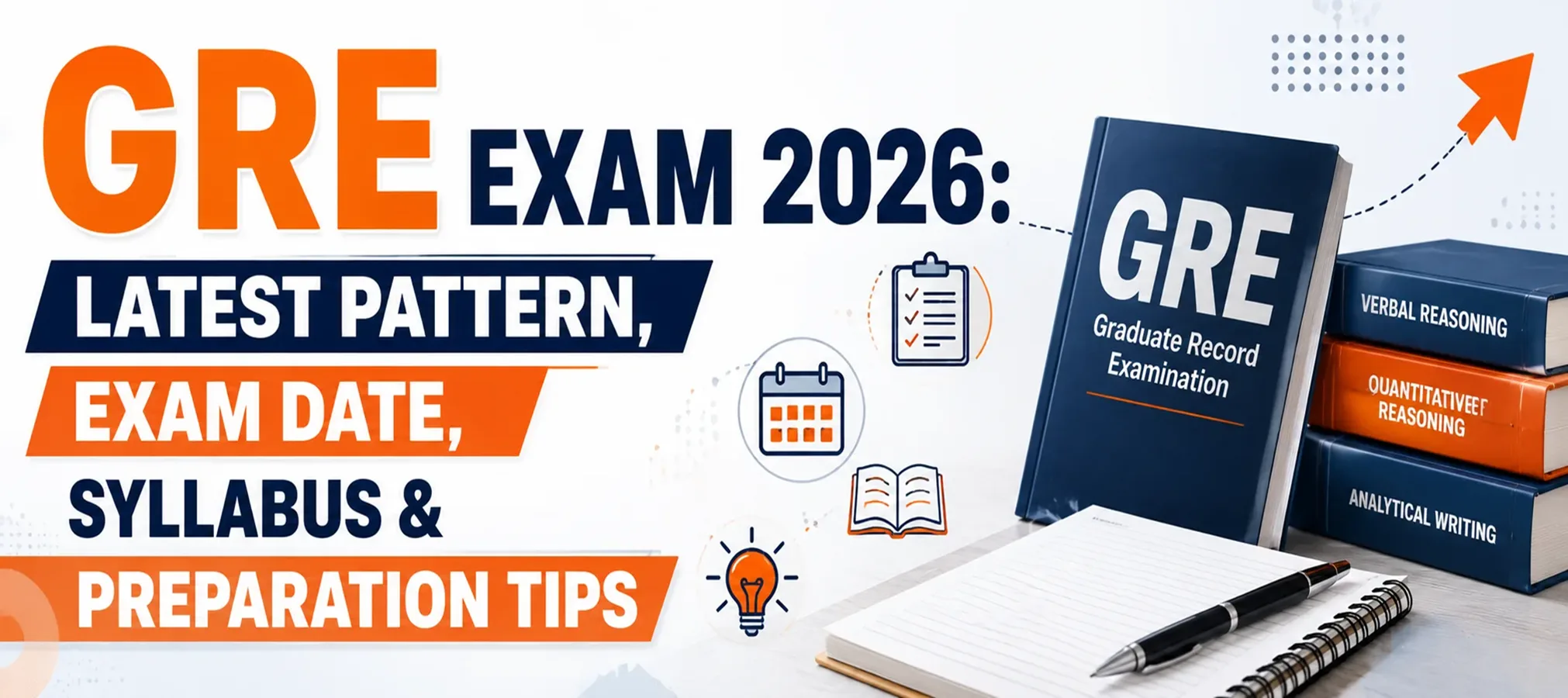
There are thousands of students worldwide pursuing higher education abroad on an annual basis, and the ETS GRE Exam 2026 is the first step in this direction. GRE Test 2026 is the eligibility criterion for master’s, MBA, and doctoral programs. This article provides comprehensive details on the format, syllabus, eligibility, cost, and preparation tips of the GRE Test 2026 for your reference.
What is the GRE Exam?
The ETS Graduate Record Exam (GRE) is a standardized test that graduate schools require applicants to take before enrolling in their desired programs. It is a mandatory criterion in lieu of admission for master’s, MBA, and doctoral degrees. Educational Testing Service (ETS), the organization that designs and administers the exam, has been operating since 1948. Moreover, numerous renowned institutes worldwide, including those in the United States, Canada, the United Kingdom, and Europe, accept and acknowledge this exam.
The GRE General Test assesses one’s verbal, quantitative, and analytical aptitude. It does not evaluate the subject-specific expertise of an applicant; instead, it analyses one’s communicative competency, logical and analytical skills, and reading comprehension. As a result, students with backgrounds in engineering, fine arts, or commerce can easily prepare for and clear the exam with a good score.
Frequently Asked Questions
GRE Exam 2026 highlights
Particulars | Details |
|---|---|
Full Form | Graduate Record Examination |
Conducted By | Educational Testing Service (ETS) |
Exam Mode | Computer-based (Test Center or GRE at Home) |
Total Duration | Approximately 1 hour 58 minutes |
Total Sections | 5 (1 Analytical Writing, 2 Verbal, 2 Quantitative) |
Total Questions | Around 55 scored questions |
Section Format | Section-level adaptive |
Analytical Writing Time | 30 minutes (1 essay: Analyze an Issue) |
Verbal Reasoning Time | 23 minutes per section |
Quantitative Reasoning Time | 26 minutes per section |
Verbal Score Range | 130 to 170 |
Quantitative Score Range | 130 to 170 |
Analytical Writing Score Range | 0 to 6 (half-point increments) |
Maximum Total Score | 340 |
Score Validity | 5 years from test date |
Unofficial Score Display | Immediately after Verbal and Quant sections |
Official Score Availability | 8 to 10 days after the test |
Eligibility | No fixed age, degree, or nationality requirement |
Retake Limit | Up to 5 times a year, 21 days apart |
General Test Fee (Global) | $220 (rising to $249 from August 1, 2026) |
General Test Fee (India) | Approx. ₹22,500 |
Subject Test Fee (Global) | Rising to $199 from August 1, 2026 |
Rescheduling Fee | Approx. $50 |
Test Center Change Fee | Approx. ₹5,000 |
Fee Waiver Voucher | 50% off for underrepresented groups |
At-Home Security Requirement | Second camera device mandatory |
Test Center Availability | 160+ countries |
Score Acceptance | Thousands of universities in the USA, Canada, UK, and Europe |
Frequently Asked Questions
Boost Your GRE Preparation with Ooshas Prep
Join thousands of successful students and start your journey today.
Why is the GRE Exam Worth Taking in 2026?
- Global acceptance: Thousands of colleges and universities in the U.S., Canada, the U.K., and Europe accept the GRE exam. Moreover, many of the schools which suspended the policy of considering GRE scores for admission due to the pandemic have allowed resuming it for specific programs.
- Fair comparison: By taking the exam, you give the admission committee an objective criterion to compare your application to that of other candidates, including international students who studied in different education systems.
- Qualify for scholarships: A high GRE score increases your chances of receiving a scholarship or graduate assistantship since many funds use this criterion to select candidates on a competitive basis when the budget for free places is limited.
- Short test: The new version of the test takes less than two hours and is not as tiring as it used to be. As a result, you will be able to sustain your concentration throughout the exam, which is critical for achieving a good result.
- Home test availability: You may take the test at home if you want to avoid the stress of traveling to a remote testing center. Such centers may be unavailable in your region if you are a student based in a small city.
- Long score validity: Your GRE scores are valid for five years after passing the test, so you have a decent window to apply to the programs of your choice. During this period, you may also consider multiple applications if needed.
- Prove competencies: Apart from general eligibility criteria, most master’s and doctoral programs require applicants to demonstrate their competencies in verbal, quantitative, analytical writing, and reading areas. A good GRE score certifies that your skill level may be sufficient to succeed in the studies ahead.
New changes in GRE Exam 2026 pattern
Total Duration
- Previously: Almost 3 hours 45 minutes long, making it an extremely lengthy examination
- GRE 2026: Approximately 1 hour 58 minutes long, making it about a third shorter
Number of Sections
- Previously: Included an additional unscored experimental section, thereby making test takers attempt more sections without any benefit
- GRE 2026: The ETS has removed the unscored experimental module from the new pattern resulting in only 5 sections for the current and upcoming years
Analytical Writing Task
- Previously: Candidates were required to write two essays – Analyze an Issue and Analyze an Argument within the Analytical Writing section.
- GRE 2026: Only the Analyze an Issue essay remains a part of the revised pattern.
Number of Questions
- Previously: Each Verbal and Quantitative section had a greater number of questions increasing the difficulty level
- GRE 2026: With lesser number of questions in each section, every candidate should focus more on scoring each question right since all of them contribute towards their final
GRE score Breaks
- Previously: Test takers were allowed only one 10-minute break in the middle of the examination
- GRE 2026: Since the revised pattern is significantly shorter, the ETS has done away with the 10-minute break; however, candidates taking the test at centers can still take a short break while the clock is stopped
Scoring
- Previously: Same scoring mechanism and score reporting procedure applied
- GRE 2026: Unchanged, verbal and quantitative reasoning sections are scored between 130 and 170 while writing is scored between 0 and 6
GRE 2026 Syllabus – Section Wise Details
Knowing the syllabus of any competitive examination is essential since it helps the candidate develop a suitable preparation strategy as opposed to studying irrelevant topics. The
GRE 2026 syllabus is not very different from what was prescribed in the previous years with only minor changes being reported this year. The primary sections, namely verbal, quantitative, and analytical writing, remain the same with the only exception being the reduction in the number of questions asked per section.
Verbal Reasoning Syllabus
This section tests a candidate’s ability to understand and analyze the information presented in front of them as well as their ability to infer, apply logic, and comprehend the relationship between the ideas presented. The verbal reasoning section consists of three types of questions:
1. Reading Comprehension
2. Text Completion
3. Sentence Equivalence
The reading comprehension passages are derived from diverse fields of study including physical sciences, social sciences, biological sciences, and arts. Some passages are long while others are short, but candidates must get accustomed to reading material from all these areas. The texts completion questions on the other hand require test takers to read a passage or a sentence with one or more blanks and fill them up appropriately. Some sentences may have more than three blanks, so sufficient practice is needed to master this area. In case of sentence equivalence questions, examinees must identify the two choices that yield a sentence with similar meanings. Having a good command of words is beneficial in this section; however, one should not just focus on expanding one’s vocabulary. Sentence equivalence questions are primarily based on the contextual usage of words instead of their meanings, so one should study how the word fits in a given sentence.
Quantitative Reasoning Syllabus
The quantitative section evaluates one’s ability to understand basic concepts of arithmetic, algebra, geometry, and data analysis. The good news is that one does not need an in-depth knowledge of these mathematical concepts beyond tenth standard. There are three types of questions that can appear in this segment: problem-solving, quantitative comparison, and data interpretation. The first type requires one to solve various mathematical problems, particularly in data interpretation. The second type, quantitative comparison, is comparatively straightforward. Although the basic question pattern remains the same, candidates should be careful about the tricks embedded in the question to avoid getting trapped. One should spend sufficient time understanding the problem and the instruction before attempting to solve the question. Moreover, one should practice using the on-screen calculator to avoid any technical inconvenience on the day of the examination. All in all, the quantitative section is more about logical skill-building and less about complex mathematical calculations.
Analytical Writing Syllabus
The analytical writing section now comprises only the analyze an issue essay with the analyze an argument essay having been discontinued in 2023. The ETS provides several topics and instructions for these essays. While one cannot disagree with the given viewpoint, one must make sure to write in accordance with the specified instructions. The candidates must know that their essays will be evaluated by trained individuals who can easily detect any dishonest or vague content. As such, they should avoid writing what one thinks but rather write what the question says. One can get access to more than one hundred and fifty topics that the ETS has in its question bank. As such, one should try practicing using the sample questions provided by the ETS.
Each essay is scored by two individuals, and the average of the two scores is taken as the final score. There are no absolute right and wrong answers in analytical writing; therefore, candidates should put their best effort in coming up with a strong essay.
Eligibility criteria for the GRE Exam 2026?
- Amongst all the other benefits of taking up the GRE, one of the most attractive factors is the eligibility criteria.
- ETS has not defined any particular age criteria for appearing on the exam.
- Also, there is no specific academic qualification required to take up the exam.
- Furthermore, ETS does not determine any nationality criteria for appearing on the exam.
- Therefore, the candidate can be anyone, from an engineering graduate to an arts or commerce graduate.
- Even the final year undergraduates can take up the examination.
- Thus, it can be said that the eligibility criteria laid out by ETS are purely flexible for almost every candidate across the globe.
- The only additional criterion includes bringing along an official identity proof.
- In case of Indian candidates, the passport needs to be produced as proof of identity as other identity proofs are not accepted by ETS.
- Similarly, the passport needs to be produced by Indian candidates at the test center.
How to register for the GRE 2026?
To register for the examination, the candidate would need to follow the below mentioned steps
- Create an ETS account- First, the candidate would need to visit the official website of ETS and create his account by filling in the required details. Specifically, the candidate would need to enter their name as mentioned in their passport to prevent any discrepancies.
- Choose the type of test- Under this step, the candidate would need to choose the type of test that they would be appearing for. Specifically, the candidate can choose between a general test and subject test. It must be noted that most universities ask for a general test score unless the candidate wishes to pursue a specialized field of study.
- Choose the test mode- Under this step, the candidate can choose their mode of test taking. Specifically, the candidate can choose between an official test center and a GRE home edition. At present, official test centers have been opened in more than one hundred and sixty countries across the globe.
- Choose the date and center- This step usually requires the candidate to choose a suitable date with reference to their preparation schedule. Simultaneously, the candidate can choose their test center using the online tool. Alternatively, the candidate can also choose the date and time for their GRE home edition.
- Fill in personal and academic details- Under this step, the candidate would need to fill in their personal and academic details for the successful registration of the examination. Specifically, they would need to ensure the correctness of the filled-out personal details and academic qualifications to prevent any discrepancies in the future.
- Review all information- Under this step the candidate would need to cross-verify all the filled-out details and ensure that everything is in the correct order. Specifically, the candidate must cross-verify the name, exam date, test mode and the contact details. After this, the candidate can move on to the final step.
- Make the payment- Under this step, the candidate would need to make the payment using a credit or debit card. Indian candidates, on the other hand, can make the payment using the UPI system which has been proved to be quicker and more convenient.
- Receive the confirmation mail- Under the last step, the ETS website would send out a confirmation mail to the candidate that includes all the required information about the examination. Specifically, the candidate must save this email for future reference as they would need this on the day of the examination.
GRE Exam 2026 Fees: A Complete Breakdown
Fee Type | Current Fee (Before Aug 1, 2026) | Revised Fee (From Aug 1, 2026) |
|---|---|---|
GRE General Test (Global) | $220 | $249 |
GRE General Test (India) | Approx. ₹22,500 | Subject to revised conversion |
GRE Subject Test (Global) | Not specified | $199 |
GRE Subject Test (India) | Approx. ₹17,800 | Subject to revised conversion |
Additional Charges-
Service | Approximate Cost | Key Condition |
|---|---|---|
Rescheduling Fee | ~$50 | Must reschedule at least 4 days before the original date for a partial refund |
Test Center Change Fee | ~₹5,000 (India) | Applies when switching your chosen test location |
Extra Score Reports | Separate cost per report | Applies beyond the free reports included at registration |
Fee Reduction Voucher | 50% off registration fee | Available for students from underrepresented groups in graduate education; also includes free premium ETS prep materials |
Frequently Asked Questions
GRE Scoring System and Score Validity
Official scores, including your Analytical Writing result, typically become available within eight to ten days after your test date. ETS sends an email notification once your full score report becomes ready for review in your online account. Your GRE score remains valid for five full years starting from your test date, which gives you plenty of flexibility for application timelines. This validity period matters if you plan to apply across multiple admission cycles rather than just one upcoming season.
Frequently Asked Questions
How to prepare for GRE 2026?
- Firstly, take practice tests to evaluate your initial performance.
- This will help to identify your major and minor areas of preparation.
- Develop a comprehensive study schedule that allows you to balance your time between Verbal, Quant, and Writing preparation.
- It is critical to improve your vocabulary for the verbal reasoning section.
- Moreover, practice quantitative tests under time constraints.
- Also, analyze your mistakes after each practice test to improve your performance.
- Furthermore, learn to practice essay outlining before writing the whole essay in one go.
- In addition, read official sample essays for both analytical writing topics from the ETS question banks.
- Besides, it is necessary to study from official ETS material only.
Conclusion
The GRE Exam 2026 gives you a fair opportunity to get admission to your dream college/university. It has a short syllabus, a transparent marking scheme, and provides you with the flexibility of giving the exam in two modes. However, it is important for you to know the GRE syllabus 2026 in depth and practice hard for the exam. Additionally, you should also invest enough time in understanding your preparation status through mock tests and sample papers. Candidates should start their preparation on time in order to get a good score in the exam. They should also keep in mind the fee structure of the exam and save money in advance because the fee is going to increase in August 2026. It is important for the candidates to understand that regardless of the mode of the exam, the value and credibility of the exam remain the same. Thus, in this way, it becomes easy for you to tackle this challenging exam with ease and score well in your first attempt. Your journey of higher education will begin with this exam.
Frequently Asked Questions
Student Questions & Comments
Have a question about your score? Ask our team and community.