The night before an exam feels strange for almost every student. You know the syllabus, you have put in the hours, and still a small voice asks, "Did I study enough?" That doubt is normal, and it does not mean you are unprepared.
Whether you are taking the SAT, GRE, GMAT, IELTS, TOEFL, PTE or the Duolingo English Test, the last 12 hours matter more than most people think. What you eat, how you sleep and how calm you stay will decide how well you recall what you already know. Here is a simple plan for what to eat, pack and revise so you stay focused until the final question.
Prepare for the GRE the Smart Way
Get GRE coaching in Jaipur with a clear study plan, regular mock tests and one-on-one doubt support.
Why is it important the night before the test?
Human intelligence does not function like a five-minute-charge smartphone. It needs rest and nutrition to power and boost its performance, so the evening before a test shape how well a person will think the following day.
1. For years now, sleep researchers have concluded that while we sleep, our brains sort the day's information, making memories that last long. Hence an all-nighter studying session will cut this crucial process short.
2. Stress also plays a role in determining the performance of a student giving an exam. Increased anxiety increases the heart rate, which in turn clouds the mind making even the simplest questions seem challenging. On the other hand, a calm evening is a sure way of giving the brain a fair chance.
3. Think of this night as a final step of the exam preparation. This does not constitute the moment to acquire new knowledge. Walking in a clear hall with a clear mind. How can students plan their evening using a simple and effective timeline?
Having a set timeline negates the need to think about anything else at this point in time. The following are the best practices at specific times during the night. Students can tweak the timeline depending on their exam hour and personal needs.
· Late afternoon: Wrap up heavy study at about four or five in the evening. From then on, do light revision only. This gives the brain enough time to slow down before going to bed.
· Early evening: Pack bags, check documents, and lay out the best-fitting clothes. Doing so early in the evening will free up the mind as one will not be in a hurry anymore.
· Time for dinner: Have a balanced meal about two to three hours prior to going to bed to give the stomach sufficient time to digest.
· Time for winding down: Do not read, have a warm bath or chat on a light note with your friend or family members. This is the time you will wind down for an hour before retiring to bed.
· Time for dinner: Have a balanced meal around two to three hours prior to going to bed to give the stomach enough time to digest.
· Time for winding down: Do not read and have a warm bath or chat on a light note with your friend or family members.
Which breathing method does the blog suggest for calming nerves?
What to eat and drinks the night before the exam?
Foods have a different effect on the mind depending on the person. However, the ideal exam night supper should not involve new or exotic meals as they can lead to indigestion. It is advised that one tries to balance the plate with foods that he knows. Foods that have carbohydrates, protein, vegetables and fat are the ideal ones. They will keep one full for a long time and boost performance. On the other hand, it is best to steer clear of spicy, oily, and overly salty meals. They can lead to heartburn and sleeplessness, especially when lying on one's side or stomach. With that said, a light and healthy meal should be taken about two or three hours before sleep.
Everything About the SAT in One Place
Check the SAT exam pattern, syllabus, eligibility, fees and important dates before you plan your prep.
Foods and drinks to avoid tonight
Eating spicy and oily foods, sweet foods, energy drinks, greasy fatty foods and drinking alcohol can cause weight gain, heartburn, indigestion, sleeping issues and increased levels of anxiety. Although you may feel more relaxed and be able to sleep better when drinking alcohol it has been proven by experts that it really does have a negative impact on your sleep. Students should always avoid anything that could cause issues with sleep or concentration when revising.
Hydration and Caffeine: Get the Balance Right
While most people know the importance of drinking enough water, they tend to overdo it in the evenings. As much as staying hydrated is essential for brain function, one should not drink too much water at night, for it will lead to several bathroom breaks in the middle of the night. Water intake should be in steady sips throughout the day. Sip some water with dinner and again before going to bed. Limiting the intake of fluids in large amounts one hour before sleeping time should be observed to prevent frequent awakening because of the urge to urinate. Another factor that should be taken into consideration is caffeine. It is advisable not to take coffee and tea in the afternoon and at night since both of them have caffeine that is a stimulant.
How can students do last-minute revision in a smart and effective way?
Many students wonder if they should study at all on this night as their preparation efforts have fructified. In case of last minute revision, it is most effective when it is done by scanning whatever is already studied instead of learning something new. Here is how to go about it:
- First things first, open up the relevant short notes, formulae, or mind maps. These contain the most crucial details that one should remember. With that said, one can scan through them in under an hour.
- Secondly, it is important to review the topics that one tends to forget rather than the ones that stick. For instance, one may want to learn out loud or write down any forgotten dates or definitions. This is an active recall of what one has studied.
- Furthermore, one should try solving two or three short practice questions to stimulate the brain. Avoid practice papers as they will take too long and, in the process, the student may not perform well on them leading to demotivation.
- After studying, it is essential to set a hard stop time and stick to it. Keep away from books at least an hour before bed, for what has not been learned on this evening will not be changed the following morning.
What to pack for exam?
Your exam day checklist
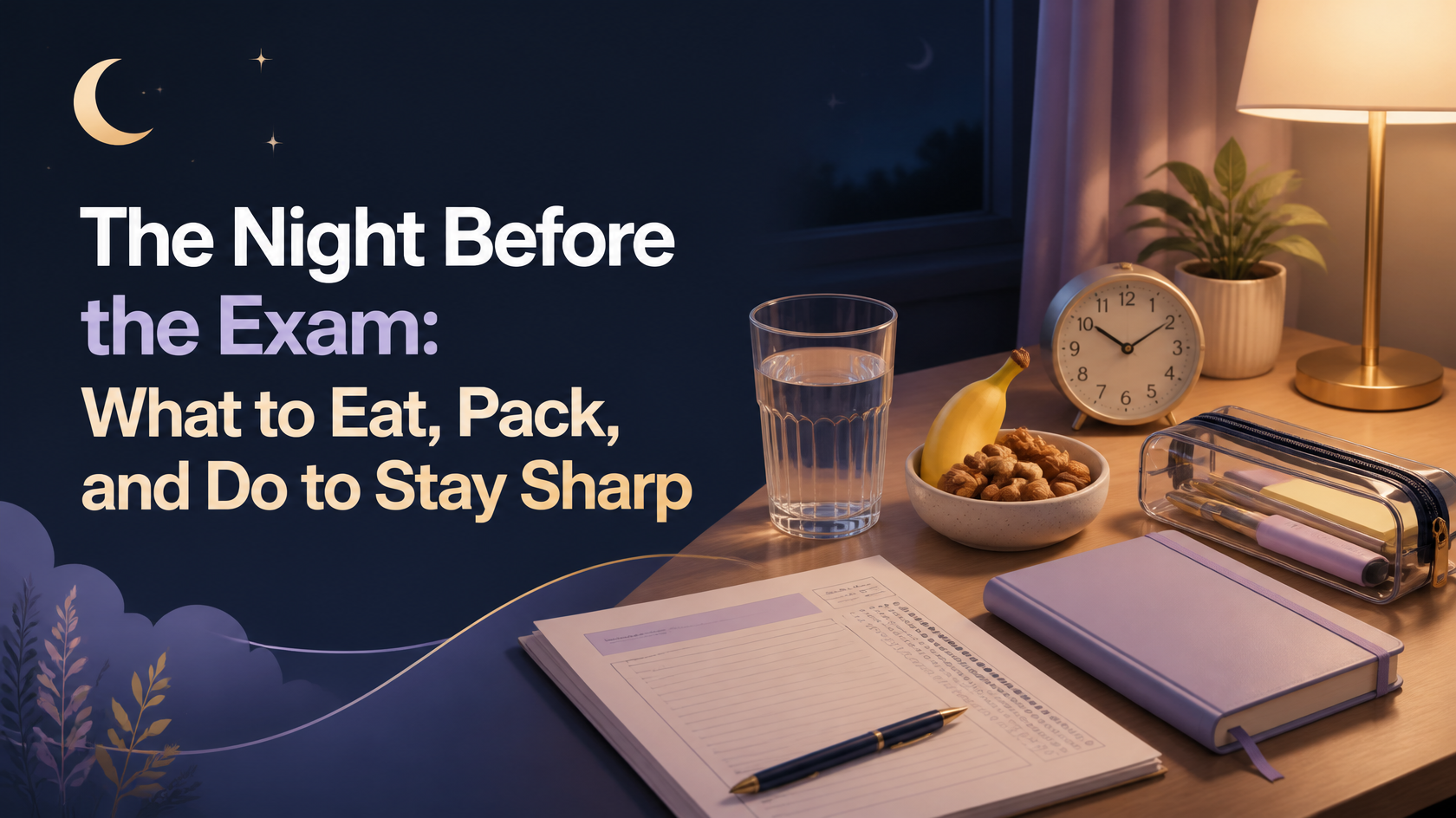
The packing night is an exciting day for most students who want to get everything ready before the exam. Consequently, list out all the important things you must carry for the exam and go through them again before leaving the house. Carrying the admit card along with a valid photograph identification is a must. Make sure to carry along with everything else the required forms or pictures. You need to make sure to carry the stationery as well. Take all the working pen, pencil, eraser, sharpener, scale and calculator/geometry box if necessary.
What to leave at home?
One must avoid carrying items that are not permitted in the exam hall like cell phones, smartwatches, earphones, notes, and any other such things. If in doubt, one must find out which items are permitted and which are not in the examination hall.
How to sleep well before the exam?
Getting good rest on the day of an exam is crucial to help with memory recollection, mood, and reaction time. According to the American Academy of Sleep Medicine, adolescents ages thirteen to eighteen should get eight to ten hours of sleep, while adults need at least seven. Of course, the nerves can hinder the sleep cycle, but the following tips will help most students fall asleep with ease:
- The need to maintain a consistent sleeping schedule is imperative. Attempting to go to bed too early does not help since the body will not take this into account and will just keep you awake and on edge.
- Dimming the lights is another strategy, as this alerts the brain that it is time to sleep. The lights should be dimmed around an hour or two prior to sleeping.
- It may be helpful to put away the cell phones. In addition, browsing Facebook pages and talking about the upcoming test adds more pressure to one's stress levels. Moreover, the blue screen light lowers melatonin production, resulting in insomnia.
- Keeping the room quiet and cool increases comfort levels during sleep. This is because most people feel asleep in a cool atmosphere. Any effort should be taken to ensure that the room is not exposed to any bright light or sound during sleep.
- Avoid pulling all-nighters as these hinder the attention and memory of the next day. Research studies have found that the normal sleepers are more likely to succeed than those who have pulled an all-nighter.
How can you revise smartly on the last night?
Many students wonder whether they should study at all. A light revision is fine, as long as you review what you already know instead of learning something new.
- Start with your short notes. Open your formula sheet, summary notes or mind maps. You can scan them in under an hour. If you are attending SAT coaching in India, GRE coaching in Jaipur, or GMAT coaching , your coaching notes and error log are the best material for this.
- Focus on weak spots. Review the topics you tend to forget, not the ones that already stick. Say forgotten definitions or formulas out loud, or write them down. This is active recall.
- Solve two or three short questions. This warms up your brain. Avoid full practice papers tonight: they take too long, and a low mock test score the night before can hurt your confidence for no good reason.
- Set a hard stop time. Keep your books away at least an hour before bed. What you have not learned tonight will not be learned tomorrow morning.
Each exam has its own light-revision habits. For the GRE and GMAT, go over your quant formulas and common error types. For the SAT, skim your grammar rules and math formulas. For IELTS and TOEFL, read your speaking and writing outlines. For the PTE Exam and the Duolingo English Test, look at your task-type tips. Keep it short.
What should you pack for the exam?
Your exam day checklist
Make a list and check it twice before you leave the house.
- Admit card or registration confirmation and a valid photo ID. Check the exact ID your test provider asks for. For many international tests like IELTS exam eligibility criteria, TOEFL, PTE, GRE and GMAT, this is usually a passport, but rules differ, so confirm with your test provider.
- Any other required documents or photographs.
- Stationery, if allowed: working pens, pencils, erasers, a sharpener and an approved calculator for tests that allow one.
- A water bottle, if permitted, and any medicines you need.
What to leave at home
Most exam halls do not allow mobile phones, smartwatches, earphones or notes. If you are unsure, check the official list of permitted items for your exam, whether it is the SAT, GRE, GMAT, IELTS, TOEFL or PTE.
What are the common mistakes students make the night before?
- Learning from the mistakes of others helps people avoid sleepless nights. Below are the common mistakes that students commit the night before exams:
- Trying to learn brand-new chapters. New topics are mostly harder to store and recall under pressure, so it is best to avoid teaching them the night before an exam. Instead, spend time scanning what has been learned to refresh the memory.
- Comparing oneself to other students. Students have different areas that they excel in and areas that they struggle in, so each student should not be worried about how other students are handling things.
- Eating no dinner. With an empty stomach, you will not have enough energy to focus on your studies, so eating something is the best thing to do.
- Studying late into the night. One hour turns into three, and the extra sleep will do more harm than good. Set the stop time and stick to it.
- Forgetting the admit card. It is such a common error committed by students that it is always better to do a recheck before stepping out of the house. Place all the necessary documents in the bag before doing anything else.
- Changing routines around. New foods, timing, and supplements are best left for another day.
Special tips for online and computer-based exams
Many tests are completed either on a computer or online. The GRE, GMAT, TOEFL, and Online PTE coaching in India are usually completed at a test centre. The SAT can now be completed online. The Duolingo English Test is completed at home. You must always check the test provider’s official website for up-to-date instructions.
Test Centre:
Bring your admit card and ID as instructed. Try to arrive early so that you don’t get stressed when having your biometrics done.
Home (e.g. Duolingo English Test):
Check your equipment, camera, microphone and internet works. Ensure your desk is clear. Close any additional tabs in your browser and ensure you have nothing forbidden. Let your family know when your test will take place so they don’t interrupt you.
Digital SAT:
If you’re taking the test on your own device ensure it is charged and bring your charger.
Which dinner suits the night before the SAT, GRE or IELTS?
Estimate Your SAT Score in Seconds
- Enter your mock test results in our free SAT score calculator and see how close you are to your target score.
A Sample Night-Before Schedule
The following is a simple sample of a night-before schedule:
- 4:00 pm: Stop studying hard. Do light exercise such as walking and stretching.
- 5:00 pm: Prepare your things, verify documents, and choose your best-fitting clothes.
- 6:00 pm: Do light revision of notes and formulae for an hour.
- 7:30 pm: Have a balanced dinner and have some water.
- 8:30 pm: Revise your weak subjects for thirty to forty minutes.
- 9:15 pm: Keep all your books away. Talk to your loved one or listen to some peaceful music.
- 9:45 pm: Take a hot shower and turn off all bright lights.
- 10:15 pm: Take slow breaths and jot down all your fears.
- 10:30 pm: Go to sleep.
Move the whole schedule earlier if one has an early exam in the morning. As long as the order is maintained, it can be modified to fit the best needs of the individual.
What to do on exam morning?
This is the last phase of preparing for the examination, and this occurs in the morning. It is essential to wake up early enough in order to avoid being late. Have a drink of water and cleanse your face. Stretch for a few minutes and have the planned breakfast.
Have a good healthy breakfast with some protein and good slow carbs. Don’t eat fatty foods and don’t skip breakfast. Make sure you have all the necessary items: pens, water bottle and admit card.
When you get to the exam don’t get stressed out and don’t talk about the exam with your panicking friends. Take deep breaths and walk calmly. Read the instructions carefully. Give yourself enough time for each question. Answer the easy questions first that you know and then move onto the harder ones.
Conclusion
Use the night prior to your exam to get your brain ready rather than cramming. Consume a balanced diet containing carbohydrates, proteins, and sufficient quantities of water; however, avoid foods that are hot, oily, and too sweet. Prepare all of the materials necessary for the examination such as the admit card, identification photo, stationery, water, medicine, and other allowed stuff. Spend your time scanning relevant notes instead of learning new subjects.
If you are getting ready for the SAT Exam, GRE Exam, GMAT Exam, IELTS Exam, TOEFL Exam, PTE EXam, or Duolingo exams, then the proper coaching can assist you in forming a preparation strategy and monitoring your scores via mock examinations. A mind that is well-rested, well-fed, and relaxed will never let you down when compared to some additional hours spent cramming.
Frequently Asked Questions
You should eat a healthy balanced meal with complex carbohydrates, and protein along with vegetables. You may have dal, rice, vegetables and curd at night. Avoid eating spicy, oily and highly sweet food items.
No, you shouldn't study all night before a test because sleep deprivation might make you sluggish, agitated, and easily sidetracked.
Teenagers need 8-10 hours and adults need 7 hours sleep on an average. However, you should not change your sleeping pattern as per your routine, you should not sleep very late at night.
Coffee/tea contains caffeine that may cause loss of sleep, so avoid drinking it at night. However, if you still want to drink them, then try to have it in mid-day or afternoon.
You should carry your admit card, photo ID proof, extra pens, pencils, eraser, water bottle etc. Always carry the updated information about your exam so that you do not miss out on anything crucial.
You can deal with exam stress by taking a deep breath and go for a walk. You can also write down your worries and talk to your well-wishers about your fears. If nothing works then you can always consult a counsellor or a medical expert for help.
No, avoid studying new topics the night before exam. However, you can go through your notes, formula sheet, important topics and the ones that you usually forget.
Take a rest and allow your mind to unwind instead of trying to push yourself to sleep. Steer clear of preparing or obsessing about the test at night.
Yes, it is always advisable to keep your clothes, shoes, bag, documents, water, stationery and everything else you will need for exam beforehand so that you do not forget anything important on the D-day.
Yes, it is always better to check the exam center address beforehand and try to reach there at least an hour before the reporting time so that you do not miss your exam due to any unforeseen circumstances and you have enough time to look for the right exam center if you get lost on the way.