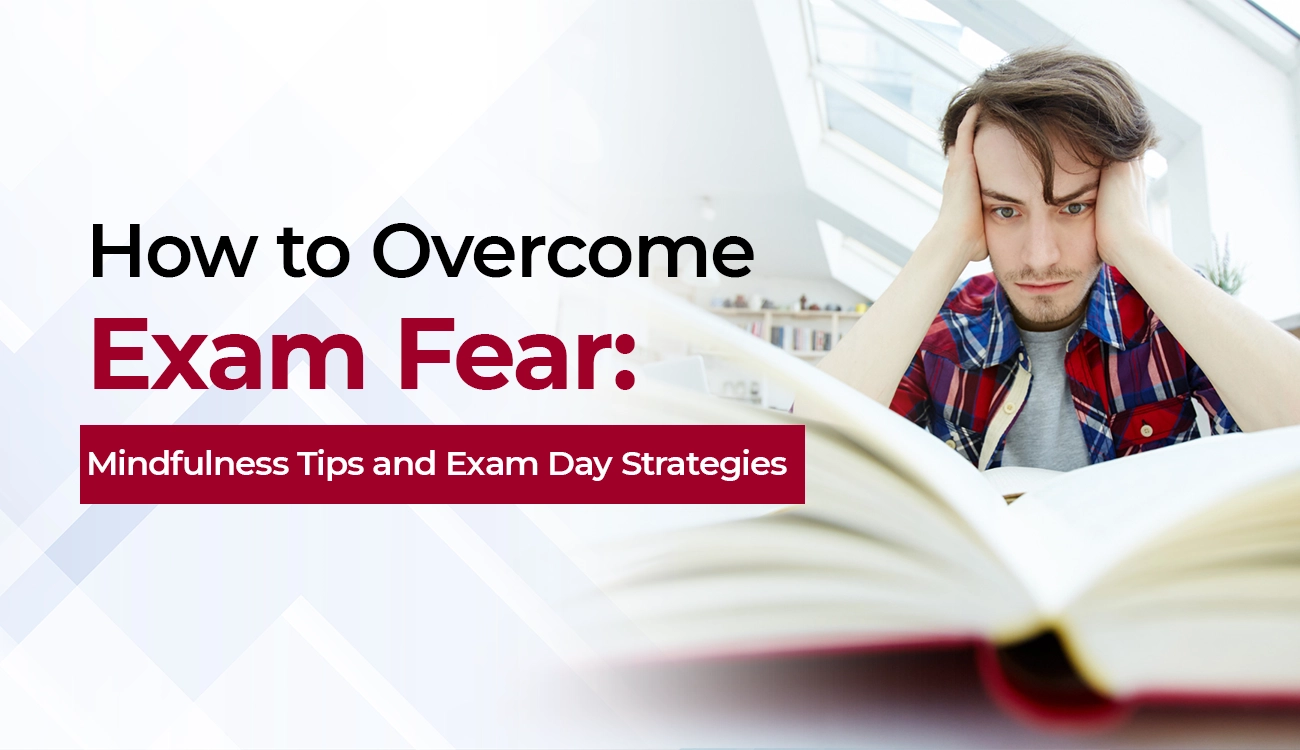
Every student must have felt the feeling of the racing heart as he/she looks at the question paper. Within minutes your confidence flies off your ears, your brain goes blank, palms start sweating. Exam anxiety is something every student of college going age and also younger ones face. In reality, worry stops you from recalling the answers you know, though most people think they don't have the ability to answer them in exams.
You will be informed about the underlying causes of exam fear and how mindfulness can help. We offer practical strategies on what to do a day before the exam, on the morning of the exam, and right inside the examination hall.
What is Exam Anxiety?
Exam anxiety can be explained as a test anxiety or can say it is a fear that arises before the exam. However, it is tough to predict exam anxiety. It is acceptable to have some anxiety since it keeps your brain aware and prepared to function. On the other hand, excessive anxiousness can be detrimental and negatively impact your exam results. There are three types of exam anxiety symptoms:
- Physical symptoms
- Negative thoughts
- Changes in behavior
For many decades, psychologists have studied the stressful nature of exams. The Yerkes-Dodson law states that while some worry is normal, excessive stress can negatively impact exam performance. To put it another way, anxiety is common, but you need to make sure it doesn't go out of control.
Why are we so anxious during exams?
There is a very simple scientific explanation for why our bodies react this way to exams. Our brains cannot differentiate between a life-threatening situation such as a lion chasing you and an everyday situation such as an exam. When your brain realizes that exam has been started then brain releases distress signals. Due to this reason your body adopt fight and flight mode and releases chemicals like cortisol and adrenaline.
This reaction may lead to shallow breathing and a racing heart during the test. Moreover, stress impairs higher-level cognitive processes, disrupting normal brain functioning. As a result, you cannot think clearly and rationally during an exam. Consequently, you are unable to recall information that should be second nature to you. The good news is that through mindfulness exercises, you can train your brain to stop responding this way to test situations.
Common Signs and Symptoms of Exam Anxiety
Exam anxiety has the advantage of being predictable. Exam anxiety symptoms are often overlooked by students, leading to them losing full capacity in their brains. You can have a better chance at controlling exam anxiety by knowing the early signs and symptoms of it. Exam anxiety typically takes form of some of the following symptoms:
Physical symptoms such as- aches and pains, stomach pain, perspiration, lightheadedness, and insomnia are among the physical signs of exam anxiety. When they pick up the pen to write, several kids also complain of shaky hands and heartburn.
Emotional symptoms: Being uncontrollable anxious, irritated, despondent, and feeling everything is meaningless is some of the common symptoms of anxiety when you have an examination. Most of the students will have similar emotions, hence do not feel that you are unique if you are having these feelings.
Mental Symptoms: A mind blanking, thinking too fast, lack of concentration, and omission of questions or even portions of the exam are among the common mental symptoms of test anxiety. Additionally, it is worth noting that you will continuously reread the same line without comprehending what is being asked of you in the question.
Do not be afraid to get expert assistance if you are suffering the majority of the signs mentioned above. Exam fear can be well controlled through mindfulness techniques. However, under extreme conditions, a visit to the doctor may be inevitable
What Is Mindfulness?
Mindfulness involves being attentive to the present moment. This is simply being conscious of what goes on around you without judging the sensations that you feel. This has been a subject of research by scholars and scientists for many years now. Many studies that have been published in peer-reviewed journals assert that mindfulness reduces students' feelings of stress and anxiety. It is hard to say for sure if mindfulness could help reduce test anxiety because people could have different results and how often they practice it matters too.
There are three ways that mindfulness might lessen exam anxiety. First of all, it enables you to realize that negative ideas are only thoughts and do not determine who you are. Secondly, by reducing body's production of stress chemicals, mindfulness lowers one's anxiety levels. Lastly, mindfulness allows one to focus on the present moment and the exam question at hand rather than one's anxiety.
One may feel that one must dedicate hours upon hours sitting cross-legged in some distant mountain to see any benefits from mindfulness. However, one need only to engage in mindfulness for a mere five minutes a day to see benefits. Any amount of practice is better than none.
How can you develop a mindfulness practice?
Mindfulness is a skill, which can be developed only with its practice. It is reasonable for any skill to have at least a good basis before starting to remember some complicated yoga postures and breathing techniques. It is suggested to practice mindfulness for two weeks prior to the exam. There should be one particular moment of the day for practicing and following your schedule in terms of time. The best way to do that is to make it a part of your everyday routine. For example, after taking a shower, you may start practicing mindfulness. You can document your progress.
The majority of people mark a tick in their calendars after the end of practice. One more thing, which can be helpful in order to track your progress, is to describe your feeling before and after each practice with the help of a scale from 1 to 10. It will remind you about how far you have gone in the process of your mindfulness. And one more thing: there are bad days.
There are seven mindfulness techniques that can help you combat exam-related fear and stress. These techniques are perfect for students, as they do not require any special equipment or training. Let's examine some mindfulness practices that reduce stress.
Method 1 of Mindfulness: Mindful Breathing
It is the easiest mindfulness technique to alleviate stress and re-focus one’s attention. It only needs your awareness and can be done anytime, anywhere. This is a very easy but effective method that will help you face your fears. You may want to give careful breathing a try that you’ll see how it works.
You can alternatively take a seated position. Once seated, you can either close your eyes or look at a particular object a few inches ahead of your face. Take a deep breath through your nose while counting from one to five over a period of five to seven seconds. Then breathe out through your mouth saying the word “Om” and drop your shoulders. Repeat the process two to five times to notice the improvement in your condition, as your breath is always longer than your intake.
Mindful breathing is one of the best techniques to apply on the exam day. You can use it during the exam with nobody noticing you. You need to train this practice for a month to really change your attitude toward stress.
Mindfulness Technique 2: Box Breathing
Box breathing is an effective form of mindfulness practiced by many athletes and health practitioners to remain calm in difficult situations. This is a form of mindful breathing which can help you gain control over your body. The following are the steps to practice box breathing:
Inhale for a count of four.
Hold your breath for a count of four.
Exhale for a count of four.
Hold your breath for a count of four.
Repeat this pattern for four to six times.
Think of tracing each of the four sides of a box as you inhale, hold your breath, exhale, and hold your breath again. That's how you get your mind to stay present so it doesn't start to take you to those scary places! Box breathing can be a mindfulness exercise to decrease your stress and anxiety, or it can be a grounding exercise to keep you calm in the test.
Method 3 of Mindfulness: Body Scan
At a test, did you ever notice just why your upper body, neck, or jaw are tight? These body parts tighten up when you're worried or upset.
The body scan exercise may also assist you in becoming aware of other areas of your body that you tighten unconsciously. Then, you may be able to relax those muscles and bring your body back to its natural position. To do this exercise:
Lie or sit in a comfortable position. Bring your attention to your toes, and notice what you notice. Try to stay aware of this feeling in your toes for as long as you can. Then, work your way up from your toes, bringing your attention to your feet, until you have scanned your body up to your face.
Notice any areas in your body that feel tense. Focus on these body parts and observe how your breath moves in and out of your body. You can also try to release the tension by focusing on your breath. However, do not judge or fight the tension simply notice it.
A full body scan takes about ten minutes. It is a good idea to scan your body in the evening before you go to sleep. You can also scan a specific part of your body during an exam. For instance, you can scan your jaw, shoulders, and hands if you are feeling particularly tense.
Mindfulness Technique 4: The 5-4-3-2-1 Grounding Exercise
Do you feel panicked, restless, or nervous during an exam? If yes, then you need to learn the 5-4-3-2-1 grounding exercise. This is a mindfulness technique that can help you reduce panic attacks and prevent you from having scary thoughts. The 5-4-3-2-1 grounding exercise works by shifting your focus away from your anxious thoughts and onto your senses. Here’s how to do this:
Look around, and name five things you can see.
Identify four things you can touch.
Listen for three sounds you can hear.
Notice two scents you can smell.
Name one thing you can taste.
If you are unable to identify smells or taste, you can skip this step or substitute it with a scent you like. This exercise will help you feel better instantly, as your mind will be occupied with sensory information. You cannot focus on scary thoughts and exam anxiety at the same time. The 5-4-3-2-1 grounding exercise can also be modified for use during an exam. Instead of naming things you see and hear, you can simply notice the texture of the chair, the feel of your feet on the floor, and the sounds around you. This version of the exercise only takes a minute to complete.
Mindfulness Technique 5: Progressive Muscle Relaxation
A form of mindfulness meditation called progressively relaxing muscles can help you release anxiety and stress. To experience feelings of tension and ease, you must tighten and then relax specific muscles in your body throughout the activity. In order to perform this practice, you first need to form a fist gesture with your whole hand for five seconds. Then, you must abruptly open your hands and monitor the release of tension from your palms.
Hold this position for ten seconds, and then move on to the next set of muscles.
Tense your upper arms and hold for five seconds. Release the tension suddenly and observe how your arms feel. Repeat this process for your shoulders, face, stomach, legs, and feet.
You should hold the tension in your muscles for five seconds before releasing it. You should never hold your breath while tensing or relaxing your muscles. If you are injured or sick, skip the areas in your body that are causing you discomfort. Always consult a medical professional before practicing progressive muscle relaxation.
This is a wonderful mindfulness practice to do before you sleep. It has a calming effect on the body and helps you fall asleep faster. This technique can also be combined with mindful breathing to help reduce stress and improve sleep quality. Mindful breathing and progressive muscle relaxation work together to reduce stress and promote restful sleep. A good night’s sleep before the exam is essential for memory consolidation and optimal cognitive performance.
Mindfulness Technique 6: Mindful Thought Labeling
Do you think negative thoughts are true reflections of reality? Most students suffering from exam anxiety believe that negative thoughts are real facts. They do not realize that negative thoughts only exist as thoughts. Mindful thought labeling helps you identify negative thoughts as simply thoughts and not facts. It also helps you create a gap between your thoughts and actions, giving you an opportunity to respond to negative thoughts in a more skillful way. To practice mindful thought labeling:
Whenever you have a negative thought, label it as a “thought” and return your attention to your breath. For instance, if your thought is “I am going to fail the exam,” you can say to yourself “Hmm, this is a worry thought.” You can then return your attention to your breath or the exam paper in front of you.
You can also label your thoughts as planning thoughts, worrying thoughts, or remembering thoughts. This will help you increase your awareness of how much time you spend having unproductive thoughts. Once you become aware of your negative thoughts, you can learn to change them using positive affirmations. Affirmations work best when they are believable to you, so it is important to choose your affirmations wisely. For instance, you can say to yourself “I have prepared well for the exam, and I will answer each question one at a time.”
Mindfulness Technique 7: Mindful Studying
Exam anxiety often originates from studying sessions. Mindful studying can help reduce exam-related stress by improving your productivity and reducing distractions. Mindful studying involves studying a particular subject for a short interval of time. Follow these steps to study mindfully:
Set a kitchen timer for every 25 to 40 minutes. Choose the interval depending on how much you can focus. Study a specific topic for this duration. It is a good idea to turn off your phone so that you do not get distracted by social media. If the timer goes off, take a short five-minute break and do not get back to studying immediately.
During your break, you can stretch your legs, drink some water, or do a few mindful breathing exercises. It is best to avoid using your phone or social media during these breaks, as these activities are unhealthy and can increase your anxiety. Do not spend more than four hours studying a day. This way, you will give your body and mind the rest it needs. You can also pay attention to how you feel as you study. You must learn to observe your thoughts and emotions without judging or reacting to them. Mindful studying can also help you reduce anxiety by giving you the opportunity to stop and breathe whenever you feel overwhelmed.
Regular speaking and writing feedback from IELTS Coaching Classes in India keeps prep steady and less stressful.
Prepare for IELTS From Home, With Expert Guidance
Live classes, regular mock tests, and personal feedback on your Speaking and Writing. Study at your own pace and walk into the exam feeling ready.
How can you relax before and during an exam?
What should you do during the week leading to your exam?
The week before the exam is crucial, and you should make the most of it. It is a good idea to keep away from all-nighters and create a proper study plan. You should also ensure that you get enough rest and exercise during this time. Do not forget to eat healthy meals and drink plenty of water. You can start your revision with your weak areas and gradually shift to your strong areas a day or two before the exam. You should also practice past papers under timed conditions so that you understand the format of the exam. It is important to familiarize yourself with the exam hall so that you are not surprised or caught off guard by the day of the exam. You can also share your fears with trusted friends and family members to get their support. At the same time, it is a good idea to avoid your classmates, as they often engage in unproductive behaviors like comparing notes and spreading rumors. They can also increase your anxiety by filling your head with negative thoughts and unnecessary information.
What should you do the day before the exam?
The night before the exam should be relaxing, so avoid studying as much as possible. Spend your time going through summary notes you created for the exam. It is also a good time to prepare your bag with all the necessary stationery and documents. Double-check that you have a valid ID in case you are asked to show it by the invigilators. Make sure to carry a water bottle and a healthy snack to keep your energy levels up during the exam. Avoid consuming caffeinated drinks and eat light meals the day before the exam. Try to avoid using electronic devices at least an hour before you go to sleep. You can also practice a body scan or mindful breathing to help you relax. Do not forget to get a good night’s sleep the night before the exam. Lack of sleep will not derail your preparation if you have studied hard over the weeks leading to the exam.
Short, regular sessions from home work well, and GRE Online Coaching in India makes that easy to fit around work or college
Everything You Need to Know About the GRE
Understand the exam pattern, sections, scoring, and registration process in one place, so there are no surprises on test day.
What should you do on the morning of the exam?
It is a good idea to wake up early on the morning of the exam so that you are not in a hurry. Rushing around on the morning of the exam can increase your stress levels before you even arrive at the exam hall. You should also give yourself extra time to get to the exam hall, as traffic or other delays can cause you to be late. On the day of the exam, it is essential to eat a healthy breakfast. Avoid eating greasy or spicy foods because they can cause stomach cramps. You should also limit your intake of caffeine as much as possible. Try to stick to healthy snacks or regular breakfast food like eggs, whole grain bread, and porridge oats. If you usually take caffeine in the form of tea or coffee, try to have your usual dose before you leave for the exam hall. It is important not to change your diet or caffeine consumption on the day of the exam. Spend five minutes practicing mindful breathing before you leave for the exam hall. You can also say positive affirmations to yourself as a reminder that you have prepared well for the exam. You should keep your affirmations simple and realistic, like “I have prepared well for this exam, and I will answer every single question.”
What should you do before, during, and just after entering the exam hall?
The most stressful part of an exam is waiting in the examination hall for the invigilators to distribute the question paper. It can be very difficult to focus when you hear other students discussing last-minute study tips. However, you need to stay calm and remind yourself that you are fully prepared for the exam. To deal with the stress of waiting in the examination hall, you can practice box breathing or the grounding exercise. It is also important to keep your phone away from you if you are not allowed to use it in the examination hall. Always follow the instructions given by the invigilators and avoid cheating. You should not cram new information before the exam begins because it will be useless to you if you do not have time to process it. Walk calmly to the exam hall and try to keep your shoulders relaxed. You can also smile to yourself as you walk to the exam hall. This simple technique can help take away some of the tension in your facial muscles. You should always take deep breaths before you enter the exam hall to ensure that you have steady and even breathing. Remember that most students feel anxious at the thought of an exam, and you are not alone.
What should you do inside the examination hall?
It is a good idea to take a minute before you pick up the question paper. Sit with your feet firmly planted on the ground and take three slow breaths with a long exhalation. Read the instructions on the question paper carefully. You should also spend a minute scanning the entire exam paper to assess its difficulty level. Next, attempt the easiest questions first so that you can build confidence and gather momentum. You should always divide the total number of marks by the total number of questions to get an idea of how much time to spend on each question. Write a note next to each question to remind yourself of the time you are supposed to allocate to it.
A computer-based format feels less scary once you've practiced it in a PTE Coaching Class in India.
What to do when your mind goes blank?
Blanks scare almost all of us at least once. They occur due to the fact that your brain is stressed and cannot access your memory for a brief period of time. It does not mean that you forgot everything.
Stop writing and put your pen. Have three slow breaths and feel the ground underneath your feet. Give yourself thirty seconds without pressure.
Move on to another question and come back afterwards. Sometimes the moment comes once your body is relaxed. You can also write down anything related to the concept, a word or even a formula, since writing can help your memory trigger.
Use the thought labeling method as well. Say to yourself that this is a blank and that is going to pass, then continue one line at a time.
Speaking into a microphone can freeze anyone, so a TOEFL Online Coaching Class in India helps you practice that pressure in advance.
What to do when panic hits suddenly?
Sometimes, anxiety can hit in the middle of the paper, which leaves your heart pounding, breath quick, and vision narrowing. However, you have to stay calm, since this unpleasant moment is not going to harm you.
The first step is to exhale for a longer period of time than you usually do, as you practiced.
Then, press your feet firmly on the ground and press your palms on your thighs.
The third step is to use the 5-4-3-2-1 technique in a quiet manner. Name a few things you see and hear around you.
If the feeling persists, ask the invigilator for help, since exam staff deals with panicking students on a regular basis and will assist you accordingly to the rules of the exam.
How to deal with the time pressure?
Time pressure causes anxiety in a lot of students. As the paper becomes more difficult, the clock seems to be ticking louder. A simple solution helps here.
Allocate time according to the marks before you start writing. Set a small checkpoint in the middle of the paper to keep track if you are on time. Increase the speed of simple questions and omit those that need too much time.
At the conclusion, give yourself a few minutes to do a fast check. You can avoid careless errors like missing units or leaving blank sections with even a quick scan. Use this opportunity to unwind rather than rushing. If your shoulders or jaw are rigid, take a few minutes to relax.
Five seconds is a sufficient amount of time for a small break that will save your energy for the whole paper.
Timed sections are the toughest part of the test, which is why many MBA aspirants join GMAT Coaching in India for structured mocks.
Building a Healthy Lifestyle That Supports Calm
Mindfulness is better practiced alongside a healthy lifestyle, since your body and brain share one energy pool. If one of them is hurting, the other will be affected as well.
Sleep is prioritized, since it is the time when your brain consolidates the information, you studied. Most teenagers and adults benefit from a proper sleep schedule and organizations around the world recommend at least seven to nine hours for adults and more for teenagers. Keep a proper bedtime schedule during the exam season.
Movement is another essential point. A brisk walk, light yoga or even a bike ride can do wonders for your stress relief. Ten minutes of activity in between your study sessions are beneficial as well.
Food and water are crucial as well. Drink water on a regular basis, eat healthy and have at least fruits, vegetables and protein in your diet. Avoid sweets and energy drinks, since they can cause a crash and more anxiety.
School students can build exam habits early with SAT Online Coaching in India.
Find Out Where You Stand With Our SAT Score Calculator
Enter your raw scores and get an estimated SAT score in seconds. It's a quick way to see your strengths and what to work on next.
What common mistakes should you avoid before and during an exam?
Cramming before the exam – Avoid studying the night before the exam. Late-night cramming leaves you both tired and unfocused. It is better to review a few key points and give your brain some rest.
Skipping sleep to study a few extra hours – Do not sacrifice your rest to gain a few extra hours of studying. A good night's rest is essential for your focus, attention, memory and overall well-being. Do your best to stick to your sleep schedule before the exam.
Ignoring food – Skipping breakfast or having a heavy meal can leave you uncomfortable during the exam. Try to have something light and healthy that you know you can stomach.
Too much caffeine – It is better to limit your coffee intake to avoid unnecessary anxiety. Too much caffeine can also trigger a physiological response, such as a rapid heartbeat.
Learning new topics – Avoid learning new topics before the exam. Focus on revision, key ideas, formulas and concepts. Concentrate on what you already know rather than what you do not.
Comparing yourself – Avoid comparing yourself to others. Other people's preparation does not reflect your own. Keep focusing on your path and your progress.
Checking notes before the exam – Constant note checking before the exam can make you more anxious. Give yourself a few minutes to relax once you arrive at the exam center.
Rushing questions – Avoid rushing through questions. Read the instructions carefully and identify what each question is asking.
Staying on one question – Do not get stuck on one question for too long. This can negatively impact your overall performance. If possible, move on to the next one and return to it later.
Panicking after a mistake – Do not panic after a mistake or a difficult question. Remember that it is only one part of the exam. Take a deep breath and refocus on the next question.
Ignoring time – Avoid checking the clock constantly. However, do not ignore it completely. Check your progress at regular intervals to ensure that you are on track.
Skipping mindfulness practice – Do not skip mindfulness practice before the exam. Remember that the techniques you use are only as effective as the practice you put into them.
A Simple Two-Week Mindfulness Plan
You can follow a simple mindfulness plan. It requires only about ten minutes a day, and you can adjust it to your liking and schedule.
Days 1-3: Mindful Breathing
Days 4-7: Body Scan + Thought Labeling
Days 8-10: Box Breathing + 5-4-3-2-1
Days 11-13: Timed Paper Practice
You can take a timed paper during Days 11-13 and use your breathing techniques before the start and in between. Day 14 and test day: Keep it light! Do your favorite technique for five minutes and trust yourself for the test day.
Conclusion
Exam anxiety can be found in most students during the exam season and it can affect your performance. Mindfulness techniques can help you identify the stress, slow down your breathing and refocus. The mentioned mindfulness techniques such as mindful breathing, box breathing, body scanning, grounding and positive self-talk are easy to practice and suitable for every day. Practice them before the exam day to feel better when the day comes. In addition to mindfulness, keep a proper study schedule, get enough rest and stay well-fed. Mindfulness is focused on helping you to feel better about stressful events, instead of eliminating them entirely. And the best way to combat exam anxiety is to acknowledge it and move on.
Even a short test like the Duolingo English Test feels easier with Duolingo Coaching in India.
Frequently Asked Questions
Exam anxiety is defined as tension or uneasiness that may arise prior to or during an exam.
Yes, practicing mindfulness on a regular basis can aid with stress management.
One easy mindfulness practice that can be done anywhere is mindful breathing.
You can start by practicing mindfulness for five minutes a day and increase the time as you like.
Yes, you can practice brief mindfulness exercises while taking an exam.
Take a deep breath, pause, read the question again, and return to it at a later time.
You can focus and feel more at ease by using box breathing.
No, consistent practice can help you better handle the stress of exams.
You should avoid cramming, too much caffeine, poor sleep and comparing yourself to others.
Prepare early and follow a similar routine as during your practice, take slow breaths and focus on one question at a time.