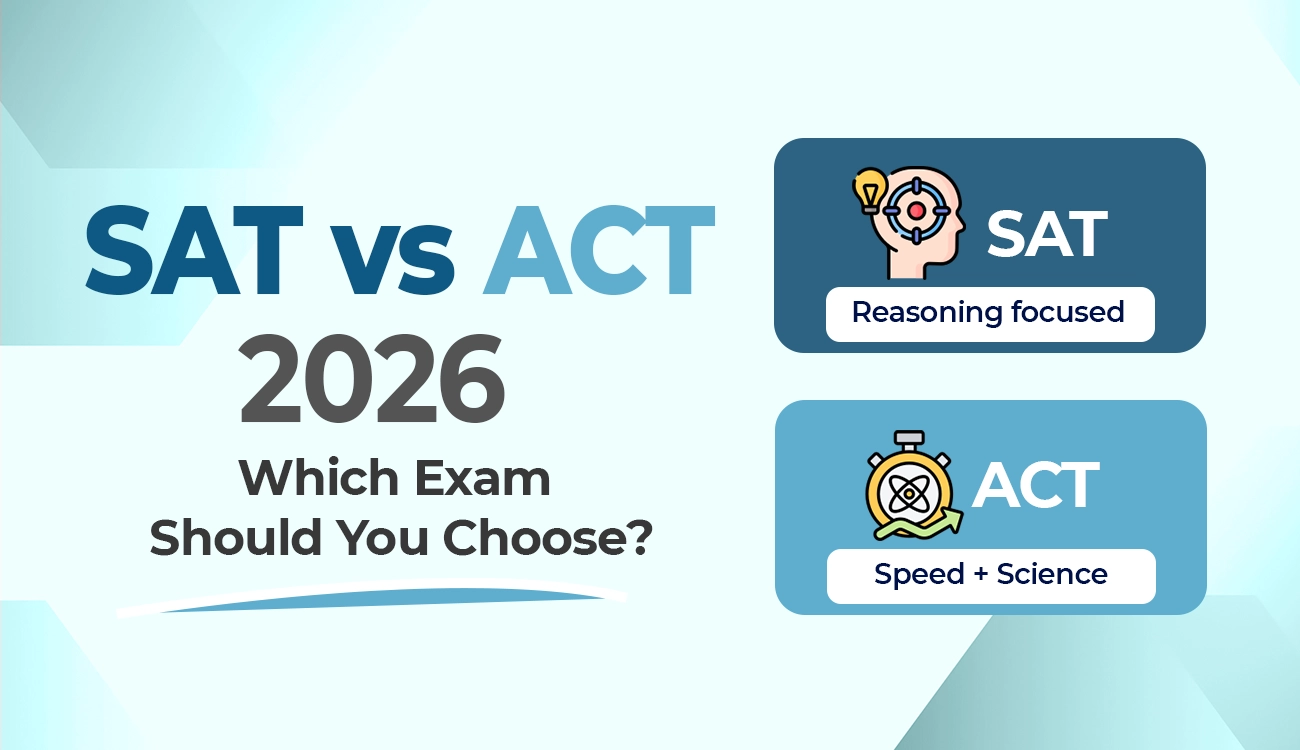
SAT vs ACT 2026: Which Exam Should You Choose?
The choice between SAT and ACT is becoming more challenging. Both exams underwent thorough revision in the last two years, and your older sibling’s advice may not be helpful. SAT vs ACT 2026 guide covers all information you need to know about the main differences between exams, their formats, scoring, and advice on what test to choose.
You do not have to rely on hearsay when making your decision – let’s discuss everything you need to know for SAT vs ACT differences 2026 to make the right choice.
What is SAT and ACT?
SAT
SAT (Scholastic Aptitude Test) is a standardized test developed by the College Board that most US Universities use as a standard for college admissions. As of March 2024, SAT is only available in a digital format. Students take the test on a laptop or tablet using an application called Blue Book, and the SAT exam consists of two modules of Reading and Writing and Math with no essay. Get SAT Exam Complete Details
SAT became more student-friendly because of its adaptation to the digital platform. First, the SAT Reading and Writing and Math modules are now shorter and can be completed in two hours and 14 minutes instead of three and a half hours. Second, the exam became adaptive, meaning that the difficulty of the second module depends on the performance of the first one. In other words, one’s performance on the first part determines the level of the second part, with Sat coaching in Jaipur higher scores receiving access to greater difficulty. Furthermore, math questions allow the use of a calculator because of the Desmos app, while the reading and writing modules only have four answer options instead of five.
ACT
ACT (American College Testing) is another standardized test students can take for college admissions, and in 2025, it announced significant changes. Enhanced ACT is scheduled to launch nationwide in Spring 2026 and will make the test shorter while maintaining the same rigor as before.
ACT used to consist of four modules: English, Math, Reading, and Science, with no essay. However, starting in 2025, the Science module will become optional. For those who do not select Science, the exam will be shorter, consisting of English, Math, and Reading modules with 131 questions and taking two hours and five minutes. In comparison, the 2025 ACT without the Science module will only take two hours and 45 minutes with 155 questions. The total score continues to be on a 1 to 36 scale, meaning that both the old and new versions of ACT will be equated.
Unlike the SAT, ACT is not adaptive, meaning that everyone receives the same set of questions regardless of where you are in the country. Furthermore, while SAT only became available in a digital format, ACT continued to offer paper-based testing for students who get anxious when taking exams on a computer screen.
Both SAT and ACT exams became shorter and less time-consuming for the class of 2026. Such changes may be beneficial for students who take the exam in 2025 or 2026.
Why is the SAT vs ACT decision different in 2026?
The decision between the SAT and the ACT exam used to be simple. Students who excelled in the sciences favored the ACT test, while those who preferred a shorter exam chose the SAT test. In 2026, however, these guidelines are virtually useless.
Below are some reasons why taking the SAT vs. ACT decision has become much harder:
Both tests are now digital: The SAT test turned fully digital in March 2024, and the ACT exam did the same in 2025, and the transition is set to be completed by spring 2026 for all school-day test takers. Now, instead of two very different pencil-and-paper tests, students must prepare for two similar computer-based exams that allow for the use of calculators (in certain sections). These small changes have a significant impact on the test-taking experience.
The science section is no longer a defining difference between the two assessments: For many years, the science section was the defining characteristic of the ACT exam, while the SAT test did not have a science section. However, with the advent of the Enhanced ACT in 2025, science is no longer an automatic requirement. This change makes the SAT test no longer an obvious choice for students who are not particularly strong in science. At the same time, the optional science section in the ACT exam means that students who are confident in their science abilities can still demonstrate their skills if needed.
The new SAT's adaptive testing format means that preparation strategies are different: The newly implemented adaptive testing format in the Digital SAT is a significant difference from the ACT exam, which maintains a linear design. As a result, the difficulty of the second module in the SAT depends on the performance of the first, whereas all questions in the ACT exam are the same difficulty. This aspect of the tests was not a significant consideration a few years ago since neither test used an adaptive design. However, in 2026, this is one of the most crucial considerations when choosing between the SAT test and the ACT exam. The difference in design means that there are different strategies for approaching each test, and some students may find one format significantly easier than the other.
Length differences are no longer significant: In previous years, the length of the two college entrance exams was one of the most significant differentiating factors. However, in 2026, this is no longer the case. The Enhanced ACT test now takes approximately the same amount of time as the SAT test (about 2 hours and 5 minutes compared to 2 hours and 14 minutes). As a result, there is little reason to choose the SAT over the ACT exam to avoid spending additional hours on a test.
The availability of calculators is no longer a significant difference between the two assessments: The availability of a calculator was once a crucial consideration, as the SAT test allowed calculator use while the ACT exam did not. However, the Enhanced ACT now provides more time per question, making it less dependent on calculator use, and the SAT testing now has a streamlined design that makes the math section no longer significantly easier. As a result, it is no longer necessary to base the SAT vs ACT decision primarily on the different policies regarding calculator use.
Everything about the SAT format, sections, and scoring — in one place
SAT Format 2026: What You Will Actually Face
The Digital SAT runs for 2 hours and 14 minutes. There is no essay section anymore, since the College Board retired it permanently back in 2021. You take the test on a laptop or tablet through an app called Bluebook, and you cannot bring your own paper test booklet even if you wanted to.
Here is the part that surprises most students. The SAT uses an adaptive testing format. That means the test adjusts its difficulty based on how you perform. Each section, Reading and Writing plus Math, is split into two modules. Your score on Module 1 decides how hard Module 2 will be. Score well early, and you unlock tougher questions with a higher scoring ceiling. Struggle early, and Module 2 stays easier, but your maximum possible score drops too.
This adaptive design changes test-day strategy in a real way. You cannot afford to rush the first ten questions of any section to save time for later ones. Early questions carry more weight than they used to, and that catches a lot of first-time test takers off guard.
The Reading and Writing section now use short passages, and each passage has exactly one question attached to it. Gone are the days of one long passage feeding five or six questions. This shift rewards students who read quickly and pick up meaning fast, rather than students who love deep, slow analysis of long texts.
Math brings good news for calculator lovers. The built-in Desmos graphing calculator is available for the entire Math section now. There is no more "no-calculator" portion to worry about. Math questions cover four areas: Algebra, Advanced Math, Problem-Solving and Data Analysis, and Geometry and Trigonometry.
Every multiple-choice question on the SAT, across every section, now offers exactly four answer choices. That is one fewer option than the old paper test used to give you, which slightly improves your odds on a guess.
ACT Format 2026: The Enhanced Version Explained
The Enhanced ACT made its biggest and final rollout in spring 2026, reaching every school-day and state testing window across the country. If you took a practice ACT a few years ago, expect a noticeably shorter and more focused exam this time around.
The core test now has three required sections instead of four: English, Math, and Reading. Science moved to an optional section, which is a massive shift from how the ACT worked for decades. English brings 50 questions in 35 minutes, Math brings 45 questions in 50 minutes, and Reading brings 36 questions in 40 minutes. That totals 131 core questions, down from 215 on the old legacy format.
Core testing time runs about 2 hours and 5 minutes without science. Add the optional Science section, and you are looking at roughly 2 hours and 45 minutes. Add the optional Writing essay too, and total testing time stretches to around 3 hours and 25 minutes.
The ACT stayed on its familiar 1-36 scoring scale, and that has not changed. But the composite score calculation did change. Your ACT Composite score now averages only English, Math, and Reading when you skip Science. If you do take Science, you receive a separate Science score on the same 1-36 scale, plus a STEM score that averages your Math and Science results together.
Unlike the SAT, the ACT is not adaptive. Question difficulty stays fixed no matter how you perform on earlier questions. Some students find this predictability comforting. Others find the SAT's adaptive style more forgiving if they have one rough section.
One more detail worth knowing: the ACT still offers a paper version inside the United States, alongside the digital option. The SAT does not give you that choice anymore. If test anxiety around screens is a real issue for you, that alone might tilt your decision toward the ACT.
SAT vs ACT 2026: Side-by-Side Comparison
Let's put the two exams next to each other so the differences actually stand out.
Feature | SAT 2026 | ACT 2026 |
Test Length | 2 hours 14 minutes | About 2 hours 5 minutes for the core test; up to 2 hours 45 minutes with science |
Format Style | Fully digital and adaptive | Available in digital and paper formats; remains linear |
Science Section | No dedicated Science section | Science is optional |
Scoring Scale | 400–1600 | 1–36 |
Calculator Use | Calculator allowed throughout the entire Math section | Calculator allowed throughout the Math section |
Essay Option | No essay; SAT Essay was discontinued in 2021 | Optional Writing essay is available |
Question Style | Shorter passages with an emphasis on precise, quick comprehension | Faster overall pace, particularly in English |
Adaptive Testing | Yes, the second module adjusts based on performance in the first | No; questions follow a fixed, linear structure |
Best For | Students comfortable with adaptive digital testing and shorter reading passages | Students who prefer a traditional, linear test and faster question pacing |
How do SAT and ACT scores compare?
Comparison of raw scores of these two exams puzzles most aspirants, which is understandable given the fact that these exams constantly change. SAT’s 1400 corresponds roughly to 31 on ACT, give or take, depending on the year of the test.
Most college and prep websites feature an SAT to ACT conversion chart - and that’s what you should do, too, after getting a real practice score. It’s a mistake to try to estimate one projected score from the other since the inaccuracies compound needlessly.
For instance, here’s one SAT ACT Timing comparison to keep in mind for the 2026 test taker: Because the ACT Composite score - based on English, Math, and Reading - is likely to have dropped out the Science test, your ACT Composite will compare more directly to your SAT Reading/Writing/Math average than before the changes in 2026.
SAT vs ACT 2026: Choosing the Right Test with Online Coaching in India
Choosing between SAT and ACT tests can be a difficult task, especially for someone who is getting ready to apply to college from India. Fortunately, most colleges accept both exams, but it is necessary to understand which of the exams one will perform better on and prepare accordingly. With the help of SAT online coaching India, students can familiarize themselves with the updated requirements for the 2026 SAT and ACT tests, practice, and determine which test to take. Additionally, professional coaching can help improve one’s skills in test-taking, time management, English, and Math. In order to accomplish this, one needs to try taking practice tests for both the SAT and ACT and then find out which gives better results. After that, a professional coach can assist an individual to come up with an action plan for the preparation for the upcoming test.
Online SAT coaching in India. Real practice data. Real results
Conclusion
There is no answer, and anyone who tells you otherwise is oversimplifying. SAT online coaching in Delhi offers a variable testing experience, with shorter passages, more adaptive pacing, and only a digital testing option. In contrast, ACT offers more consistency, speed, and flexibility in administration (paper or digital). Take at least one full practice test of each variety and see how you felt about both experiences. Consider not only your raw scores on the practice tests but your overall aptitude for each testing style.
The exam you choose should allow you to test your best, both in terms of your natural skill level and your ability to stick to a test-prep schedule that accommodates your lifestyle.
Remember that both tests are designed for 2026 aspirants to be shorter, more flexible, and less draining than the experiences their parents or older siblings had.
Frequently Asked Questions
Yes, since March 2024, the SAT has transitioned to a fully digital format, eliminating the option for paper-based testing.
The Enhanced ACT is not fully computer-based since it is offered in both formats (paper and digital) within the US, whereas the SAT has transitioned too digital-only.
Now they are almost similar in length; ACT core is 2 hours 5 minutes, while the SAT core is 2 hours 14 minutes.
Yes, it is now adaptive. Depending on your first module, the second module will be adjusted as easy or difficult.
ACT is not an adaptive test, meaning that the test will have the same level of difficulty for everyone who takes it.
Yes, since the test has become digital; Desmos calculators are available for all math questions.
Yes, most colleges do super scoring for both tests, in which your highest section scores across all test attempts are combined for your final score.
Yes, colleges can super score your legacy ACT with your new enhanced ACT.
You can take one practice test for each of the tests, compare your scores, and pick the one you feel comfortable doing. Do one more practice test under timed conditions, and see which one you think you may perform better on.