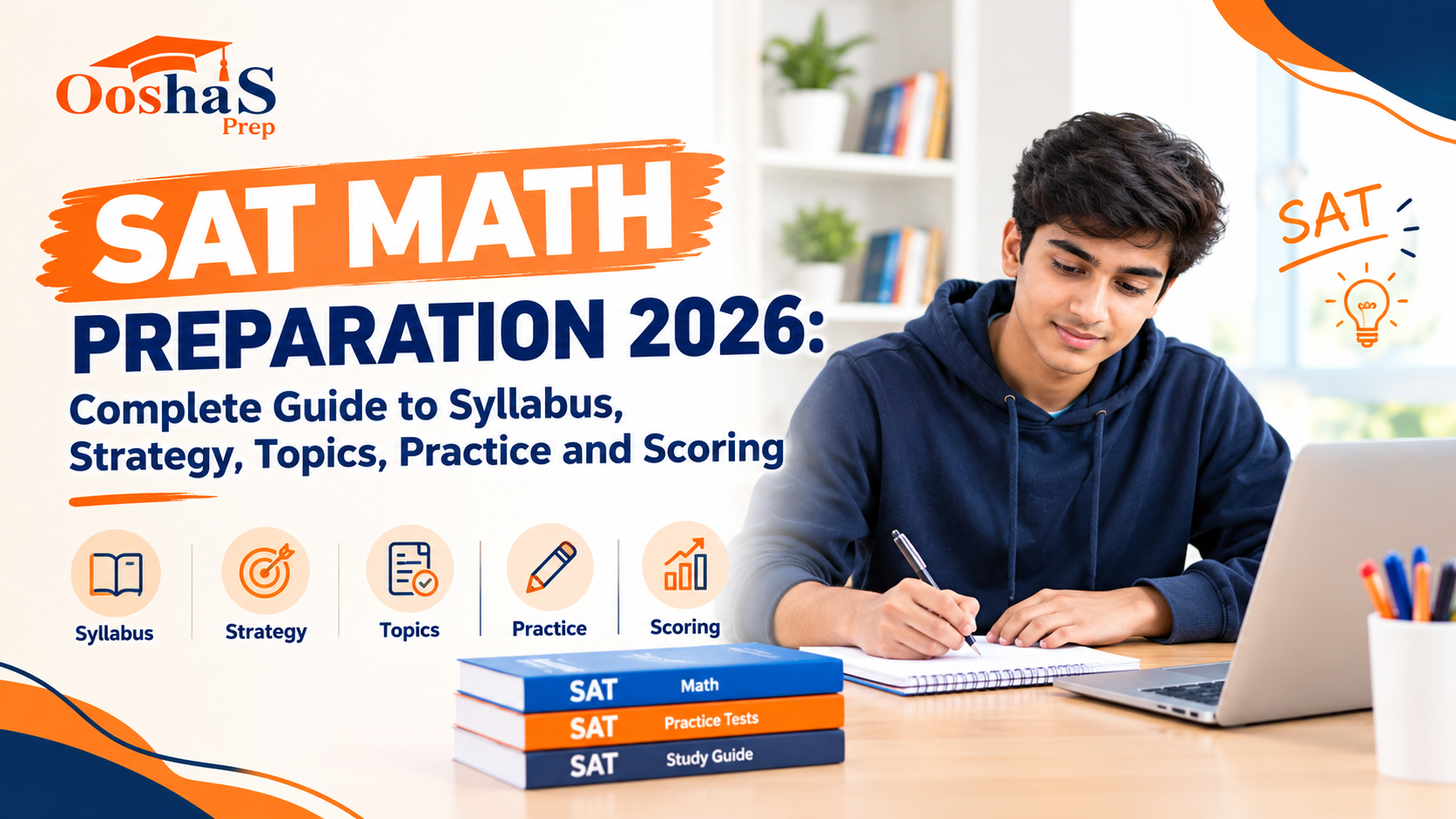
It will be easier for those test-takers preparing for the SAT math test in 2026 to prepare for this examination when they know the format of this test beforehand. It should also be noted that it is not necessarily about one’s ability to solve difficult mathematical problems but about their capability to deal with specific concepts and apply their knowledge within a 35-minute time limit.
SAT Math examination consists of 44 questions arranged into two sections where 35 minutes is allocated to answer each section. Therefore, each question requires approximately one minute and two seconds to be answered (in total it is 70 minutes). Moreover, SAT Math examination consists of four types of questions which are called Algebra, Advanced Math, Problem Solving and Data Analysis, and Geometry and Trigonometry. First two types take 35% of total examination while last two take 15% each.
The above information related to the SAT with redesigned format is provided in the following SAT Math Prep 2026 guide, which also includes everything that you need to know about important aspects of the test, preparation for them, the use of calculators, important practice tests, time management, common errors to avoid, and study plan.
What is the SAT Math Section in 2026?
SAT Math assesses math skills that one must have for both higher education and practical application.
College Board divides SAT math problems into two modules with 22 problems each.
35 minutes are provided for each module, which indicates that 70 minutes are allocated to answer 44 problems. Problems are placed in such a way that they form a pattern of increasing levels of difficulty. It is imperative to read the problem carefully before selecting the right answer.
Furthermore, you can also expect multiple-choice questions and student-produced response questions. The latter requires you to type the answer instead of choosing from the available options.
The redesigned SAT Score has an innovative adaptive testing format. This feature allows the test – maker to adjust the difficulty level of the following Math module according to your performance in the first module. If you find the initial module easy and score high, the second module will be more challenging, and vice versa. Hence it would be wise to not waste your precious time on the first module.
- The maximum mark that can be achieved by an SAT test-taker in math is 800, and your total SAT mark can be anything between 400 and 1600. There is a benchmark mark which has been established by the College Board for SAT Math, and it is 530. In other words, 530 marks is the minimum marks that one must secure to be ready for college and career. However, different universities have their own benchmark marks.
Not Sure Where You Stand? Calculate Your Estimated SAT Score in 2 Minutes
What are the four math domains you have to learn for the SAT Math Syllabus 2026?
There are four key areas tested in the Digital SAT Math exam, and they are weighted differently. It is critical to understand how much each area is weighted in the exam. Some students fall into the trap of concentrating on less weighted domains, which makes them miss out on important problem areas. The four domains are:
- Algebra constitutes approximately 35 per cent of the SAT Math exam and is further broken into its constituent subareas. Algebra is the lingua franca of the mathematical SAT and is the easiest of the four content areas to master. The questions require knowledge of linear equations and inequalities, systems of linear equations and inequalities, and linear functions. Algebra is the easiest content area to master and the most rewarding in terms of the scores obtained.
- Advanced Math also constitutes approximately 35 per cent of the Math section and is often found to be the most challenging content area. Algebraic expressions, quadratic equations, polynomial expressions, exponential expressions, and nonlinear systems of equations are all part of advanced math. A lot of students find this area challenging simply because they did not understand the underlying principles of math in school.
- The Problem-Solving and Data Analysis constitute about 15 per cent of the Math section. This area makes up for the real-world application of math and is further broken down into its constituent areas. The questions in this content area demand that students apply mathematical reasoning to solve real-world problems. Ratios, percent's, and unit conversions are all part of the problem-solving and data analysis. Approximately 30 per cent of all math questions in the Digital SAT are based on real-world applications. That is not to say that the other 70 per cent of the math questions do not have any real-world application.
- Geometry and Trigonometry constitute about 15 per cent of all the questions. That works out to between five and seven questions per test. Questions are asked on area, volume, angles, and circle equations. Students who have taken geometry classes in school should be able to handle the concepts of geometry and trigonometry. The SAT math test does not involve a lot of trigonometry. There is no requirement for students to know the unit circle or any advanced concepts of trigonometry. Calculus is not part of the SAT Math Test.
Algebra and Advanced Math make up about 70 per cent of the entire math section. It is important for the students to concentrate on these two content areas and leave the other two for later. It is easy to get bogged down in the minor details of geometry when one understands the bigger picture of algebra and advanced math.
SAT Math Domain Approximate Weight Questions Algebra 35% 13–15 Advanced Math 35% 13–15 Problem-Solving and Data Analysis 15% 5–7 Geometry and Trigonometry 15% 5–7
College Board confirms these four content areas and their approximate question ranges for the SAT Math section.
Everything You Need to Know About SAT 2026 — Dates, Fees, Pattern & Eligibility
How to prepare for Algebra?
Start with basic equations, and then gradually add problems with graphs and applied questions. For each problem, discuss aloud or write a sentence that shows your thought process after solving it. This approach will allow students to realize whether they truly understand the concept or just know how to solve a typical equation.
Additionally, students need to work on moving from one form of math representation to another. It is a common question on the SAT.
2. Advanced Math for SAT Preparation
Advanced Math represents approximately 35% of the SAT Math section, making it equally important as Algebra. This area includes nonlinear relationships and equations. Students should become comfortable with expressions involving powers, roots, quadratics, and other nonlinear forms. Important topics include:
- Quadratic equations
- Quadratic functions
- Polynomial expressions
- Exponential functions
- Radical equations
- Rational equations
- Absolute value
- Factoring
- Equivalent expressions
- Nonlinear graphs
- Zeros and solutions
- Function relationships
How to prepare for Advanced Math?
Start off with algebraic manipulation since Advanced Math requires extensive knowledge on this area. Try to be proficient with factoring, expansion, simplification, and manipulating equations.
Then move toward quadratic and exponential questions. After learning each topic, solve mixed questions rather than completing hundreds of questions from one narrow category. Mixed practice helps students identify the correct method without receiving a topic label beforehand.
3. Problem-Solving and Data Analysis
Problem-Solving and Data Analysis makes up about 15 percent of the Math test. This topic area links math to tables, percentages, ratios, statistics, probabilities, and real world scenarios. Students need to prepare for topics like:
- Ratios
- Rates
- Percentages
- Unit conversions
- Proportions
- One-variable statistics
- Mean and median
- Probability
- Data interpretation
- Tables
- Graphs
- Scatterplots
- Two-way tables
- Percent increase and decrease
How to improve Data Analysis?
Read the question before calculating anything. Identify the information provided, the required value, and the mathematical relationship connecting them. For percentage questions, students should distinguish carefully between percentage points and percentage changes.
For statistics questions, they should understand what the mean or median represents before calculating it. Students should also become comfortable reading graphs quickly. A graph can contain useful information that makes a long calculation unnecessary.
4. Geometry and Trigonometry
Geometry and Trigonometry represent approximately 15% of SAT Math. Students should prepare the most commonly tested relationships instead of trying to memorize every formula from school mathematics. Important areas include:
- Area
- Volume
- Circles
- Triangles
- Right triangles
- Pythagorean theorem
- Similar triangles
- Angles
- Parallel lines
- Coordinate geometry
- Basic trigonometry
- Sine
- Cosine
- Tangent
Is a calculator allowed on SAT Math in 2026?
Yes. Students can use an approved calculator throughout the entire SAT Math section. College Board allows the embedded Desmos calculator in Bluebook and approved handheld calculators.
The embedded calculator provides scientific and graphing options. Students can switch between these options during the Math section. College Board does not allow calculators with CAS functionality, which can perform certain symbolic algebra operations. Students should therefore check their calculator before test day.
Should You Use Desmos?
Students should learn the Desmos calculator because it appears directly inside Bluebook. However, students do not need to use it for every question. A SAT calculator can help with:
- Graphing equations
- Finding intersections
- Checking numerical calculations
- Working with decimals
- Comparing values
- Solving certain equation-based problems efficiently
However, simple calculations can at times be done more quickly without the calculator than with the calculator. Thus, the student must know how to determine when to use the calculator and when to make use of simple math. College Board recommends the use of the calculator the student will use in the real test.
How can you manage your time effectively during the SAT Math Section of 2026?
- Divide the 70 minutes that the SAT Math section provides you by 2, giving yourself around 35 minutes per module. Try to make progress on questions rather than struggling on one hard question.
- Work on easier questions first, and do not get stuck on questions that seem to require lengthy calculations. Mark questions as you go that seem too hard, and move on to ones you feel confident about.
- The calculator is not always your friend. Use it for long calculations, but think about questions that seem simple enough, or that you can do in your head, and save the calculator for later.
- Try to keep track of how much time you spend on each test, so that you can work at a pace that feels comfortable to you.
- Leave yourself a few minutes at the end of each module to go back and make sure that any questions you marked are actually correct.
- Take practice tests, with a timer, often. Know the types of questions that appear, so that you can recognize them quickly and work faster instead of wasting time on a random question. Know when to use a strategy for a question type, and how to work out the answer quickly.
- Do not rush through the first few questions, because mistakes there could waste precious time later on.
How to approach a difficult SAT Math Question?
- Do not assume advanced math: do not automatically think that a question is too hard simply because it seems to require advanced math.
- Understand the question: figure out exactly what the question is asking you to find.
- Get the important stuff: underline or note the important things such as numbers, variables, equations, or conditions given.
- Get a grip on the problem: decide if you will need an equation, graph, table, formula, or calculation to solve the problem.
- Expect a shortcut: sometimes, a problem may look like it would require a really long set of calculations, but there may be some info in the question that will allow you to find the answer more simply.
- Skip the hard questions: do not spend a huge amount of time on one question, especially if you are not making progress; come back to them later if you have time.
- Save your time: moving on to the next question is always a good idea, rather than trying to figure out a very hard question; this will save you time if you get stuck.
- Do not panic: There is always an answer to a SAT Math question, so try to break the problem down and do not be intimidated.
Student-Produced Response Questions
Some SAT Math questions require students to enter their own answers instead of selecting an option. College Board refers to these as student-produced responses. Students should practice these questions separately because the response format differs from multiple-choice questions.
Official practice instructions explain that students must enter only one answer when more than one equivalent form exists. Moreover, there are particular rules for fractions, decimals, negative solutions, and solution length. Hence, students must not use dollar signs, commas, and percent signs in their answer if the question does not require them. Careful answer entry matters because a correct calculation can still produce an incorrect recorded response if students enter it incorrectly.
What is the best SAT Math Preparation strategy for 2026?
- Start with a diagnostic test in Bluebook- before embarking on a study plan, take one official practice test in Bluebook to see what areas you struggle with: this is more honest than any guesswork based on your perceived strengths and weaknesses.
- Prioritize Algebra and Advanced Math- Algebra and Advanced Math comprise around 70% of all SAT Math questions. Focus on building strong foundations in linear and systems of equations, quadratics, exponentials, and linear functions.
- Treat Module 1 accuracy as your top priority-The accuracy in Module 1 determines how much harder questions you will get in Module 2. A mistake in an easy question will compromise your ability to answer harder questions, capping your score lower than it could be: mistakes in later modules will have a smaller impact on your final score.
- Differentiate between silly mistakes and conceptual misunderstandings- when reviewing past mistakes, classify them as one or the other. To minimize silly errors, practice slow and steady while reading the questions carefully; to deal with conceptual mistakes, learn the underlying concepts.
- Practice with a timer from the get-go- untimed practice makes you good at math but not at math under pressure. Aim for 95 seconds per question on average: this will give you enough time to solve the easiest questions. More complex ones will require more than that.
- Learn to use the Desmos calculator- the SAT Math test includes questions that require Desmos or other graphing tools. Knowing how to operate Desmos in advance will save you precious time during the exam: use it to graph or solve equations whenever possible.
- Do not neglect word problems- SAT Math is all about word problems. Practising by solving them will sharpen your ability to extract meaning from a question: this helps in all areas of the test, not just math.
- Structure your practice around weekly sessions, not daily ones- the recommended amount of practice is four to five times a week, with sessions lasting 45 minutes each. Daily practice can burn you out faster than a steady diet of weekly sessions.
- Save full-length practice tests for the end- in the early stages, focus on individual question types. In the last month, shift to full-length practice tests almost exclusively.
- Review all mistakes thoroughly- go over every single mistake from your practice tests and mark them as conceptual or silly. Question reviews help you retain information better than any other method, so they are your best bet for improving your score.
- Do not hyper-focus on your strong areas. While it is important to practice all areas, try not to spend too much time on your strongest areas. This will give you more time to improve upon your weaker areas, raising your overall score.
- Make sure your device is updated and charged to 100%. Before the final week, take a practice test on the device you will use for the exam to ensure there are no technical issues. Avoid cramming in the last few days: get plenty of rest in the final days before the test.
Building a Realistic Study Plan
A good SAT Math study plan starts with an honest diagnostic test, not a random collection of practice questions. Take one full official practice test inside Bluebook before you decide what to study. This single step reveals your actual strengths and weaknesses far better than guessing based on how a topic felt back in school.
Once you have your diagnostic results, sort your mistakes into two categories: careless errors and true knowledge gaps. Careless errors happen when you understand the concept but rush, misread the question, or make an arithmetic slip. Knowledge gaps happen when you genuinely do not know how to solve a certain type of problem. Treating these two categories the same way wastes valuable study time, since they need completely different fixes.
For students with several months before test day, a steady weekly rhythm works better than cramming. Spend the first few weeks reviewing algebra and advanced math fundamentals, since these domains carry the most weight. Move into geometry, trigonometry, and data analysis once your algebra foundation feels strong and consistent. In the final month, shift almost entirely toward full-length, timed practice tests that simulate real exam conditions.
Consistency matters far more than long, exhausting study sessions. A focused 45-minute session four or five times a week beats a single three-hour cram session on a Sunday. Short, regular practice keeps concepts fresh in your memory and prevents the burnout that often derails longer study plans. Students preparing for 2026 test dates should treat SAT Math prep like training for a sport, with steady repetition instead of last-minute sprints.
Always review your mistakes after every practice session, and never skip this step even when you feel tired. Write down why you got each question wrong, whether it was a silly slip or a real gap in understanding. This habit alone often produces bigger score gains than solving dozens of new Sat Online practice questions in India without reflection. Over time, you will notice patterns in your mistakes that point directly toward what to study next.
How many hours should you study for SAT Math?
The right study time depends on your current mathematics level, target score, school workload, and test date. Students with strong fundamentals may need less preparation than students who have forgotten important algebra concepts.
Instead of following an identical daily schedule, measure progress through practice results. For example, students can study 60 to 90 minutes per day, five days each week, when they have several months available.
Students with shorter preparation windows can increase daily practice while maintaining regular breaks. The important point involves consistency. Studying for five hours once a week usually provides less useful practice than completing focused sessions throughout the week.
Top Resources for SAT Math Preparation in 2026
- College Board resources: Start with official College Board materials because they closely match the real SAT format and question style.
- Bluebook app: Use Bluebook for free full-length digital SAT practice tests. Practicing digitally also helps students become comfortable with the test interface.
- Adaptive practice tools: Use reliable online platforms that provide targeted practice based on your mistakes and weaker Math domains.
- Student Question Bank: Practise individual questions from different SAT Math topics and focus extra time on areas where you need improvement.
- Online communities: Study groups, forums, and educational videos can provide useful explanations, strategies, and sat online coaching, practice discussions.
- Tutoring: Consider a tutor when you have persistent difficulties with specific topics or need personalized guidance.
- Independent practice: Combine all resources with regular self-practice to build accuracy, speed, and confidence.
Understanding SAT Math Scores and what they mean
The SAT Math score ranges from 200 to 800, and it combines with the Reading and Writing score to form your total score out of 1600. Scoring relies on a system called item response theory, which weighs the difficulty of each question rather than simply counting correct answers. This means two students who answer the same number of questions correctly can still receive different scores, depending on which module they reached.
A total score around 1000 to 1060 represents the current national average across all test takers. A score near 1200 places you around the 75th percentile, which many mid-tier colleges consider a strong application signal. Scores of 1400 and above are generally competitive for selective universities, while 1500 or higher places a student in the top one or two percent nationally. Knowing where you currently stand helps you set a realistic target score before you begin your SAT Math prep online India journey.
Score reports now arrive within about two weeks of your test date, which is much faster than the old paper format ever allowed. This quick turnaround gives students more flexibility to plan a retake if their first score falls short of their goal. Many students choose to take the SAT two or three times, using each attempt to fine-tune their pacing and target their weakest domains.
What are the common SAT Math Preparation mistakes students should avoid?
- Studying Only Difficult Questions: Some students immediately focus on the hardest SAT Math problems. However, strong performance also requires consistent accuracy on easy and medium-level questions. Build accuracy first, then gradually increase the difficulty level.
- Ignoring Algebra: Students sometimes spend too much time memorizing Geometry formulas while giving less attention to Algebra. Since Algebra accounts for about 35% of SAT Math, students should give this area major attention during preparation.
- Using the Calculator for Everything: A calculator can save time, but using it for every calculation may slow you down. Use mental math’s when the calculation is simple and use the calculator when it provides a clear advantage.
- Memorizing Without Understanding: Memorizing formulas is not enough. Students should understand when and how to apply each formula and connect it with practical examples.
- Taking Practice Tests Without Reviewing Them: A practice test has limited value if students only check their scores. Review incorrect answers, guessed answers, and questions that took too much time.
- Ignoring Word Problems: About 30% of SAT Math questions are presented in context. Students should therefore practice reading mathematical information carefully and applying concepts to real-world situations.
How to review SAT Math mistakes?
| Question | Topic | Mistake | Correct Method | Future Action |
|---|---|---|---|---|
| Q1 | Algebra | Sign error | Rearrange carefully | Check signs |
| Q2 | Geometry | Formula confusion | Review area formula | Practice triangles |
| Q3 | Data | Misread graph | Read labels first | Practice graphs |
| Q4 | Advanced Math | Concept gap | Review quadratic functions | Complete targeted set |
How SAT Online Coaching in India Helps You Crack SAT Math Faster
Preparing for SAT Math on your own can mean months of guesswork — solving random questions without knowing which topics actually move your score. Online SAT coaching in India removes this guesswork and gives you a faster, more structured path to a top score.
1. Personalized Diagnostic-Based Learning
Instead of studying everything equally, online coaching starts with a diagnostic test to identify your weak areas — whether it's Algebra, Data Analysis, or Advanced Math. This lets you focus your time only where it's needed, cutting prep time significantly.
2. Concept Clarity with Expert Mentors
Experienced SAT Math trainers break down complex topics like functions, quadratic equations, and trigonometry into simple, exam-focused methods — not textbook-heavy explanations. This builds speed and accuracy, both critical for the SAT's time-bound format.
3. Access to Structured Study Material & Question Banks
Good online coaching platforms provide topic-wise practice sets, previous-pattern questions, and Bluebook-style digital mock tests, so you practice exactly how the real exam works — no surprises on test day.
4. Mock Tests and Analytics of Performance
Regular mock tests, whether on a weekly or bi-weekly basis, give detailed report cards on your scores, thereby helping you keep pace with your performance. This way, you will be able to find out the type of questions from where you lose scores.
5. Flexibility of timings for Indian Students
Online Coaching enables students to prepare themselves for any exam by providing recording facility, doubt clearance, and live batch as per Indian timings.
6. Smart Strategies, Not Just Practice
Beyond content, coaching teaches time management, elimination techniques, and calculator-vs-no-calculator strategy — the tactical edge that separates a 650 scorer from a 750+ scorer.
Result: Instead of spending 6+ months prepping blindly, structured online coaching helps students achieve the same score improvement in 8–10 weeks, with clear tracking and expert guidance at every step.
Get Personalized SAT Math Coaching from India's Top Mentors — Score 750+ in 10 Weeks
Conclusion
Effective SAT Math preparation in 2026 requires a balanced approach that combines concept clarity, regular practice, and proper time management. Students should begin by understanding the four Math domains and identifying their strengths and weak areas through a diagnostic test. Regular practice can improve accuracy, speed, and confidence.
Students should use official resources such as College Board, Bluebook, and the Student Question Bank to become familiar with the digital SAT format. Reviewing mistakes is equally important because it helps students understand weak concepts and avoid repeating errors.
Students should practice both easy and difficult questions while maintaining accuracy. Timed practice can also improve pacing and reduce pressure during the actual test. A structured study schedule, consistent revision, and targeted practice can help students strengthen their mathematical skills and approach SAT Math 2026 with greater confidence.
Frequently Asked Questions
Students receive 70 minutes for SAT Math, divided into two 35-minute modules containing 22 questions each.
The SAT Math section contains 44 questions, with 22 questions appearing in each module.
Yes. Students can use an approved calculator throughout the entire Math section, including the embedded Desmos calculator.
SAT Math covers Algebra, Advanced Math, Problem-Solving and Data Analysis, and Geometry and Trigonometry.
Algebra and Advanced Math each account for approximately 35% of the Math section.
Yes. Bluebook provides an embedded Desmos calculator with scientific and graphing options for the Math section.
The SAT Math section receives a score from 200 to 800, while the total SAT score ranges from 400 to 1600.
Beginners should first take an official diagnostic test, identify weak areas, review fundamentals, and then begin targeted practice.
Students can use Bluebook practice tests, the official Student Question Bank, and College Board's downloadable practice tests.
Students should combine concept review, targeted practice, timed modules, calculator training, full-length tests, and detailed error analysis.