



Many students studying for their MBA make common mistakes due to incorrect advice or out-of-date resources. Students may follow old blogs and videos that still describe the GMAT exam as it was before the Introduction of the GMAT Focus Edition. As this can lead to students focusing on incorrect content, solving incorrect GMAT Practice Questions, and confusion regarding the GMAT Exam Dates for 2026, this blog will help to clarify any confusion. With the up-to date information from 2026, you can make smart decisions and avoid costly mistakes. We have also included what situations a GMAT Practice Test would be beneficial for, and how to make a wise choice when choosing GMAT Coaching in India. Be careful to make the right choice in each of these myths below as making one correct decision can save you money, effort, stress, and precious study time!
Which section was removed in the GMAT Focus Edition?
Learn GMAT with Mentors Who Guide You Step by Step
Live classes, regular practice and personal doubt support, built around your target score and your schedule.
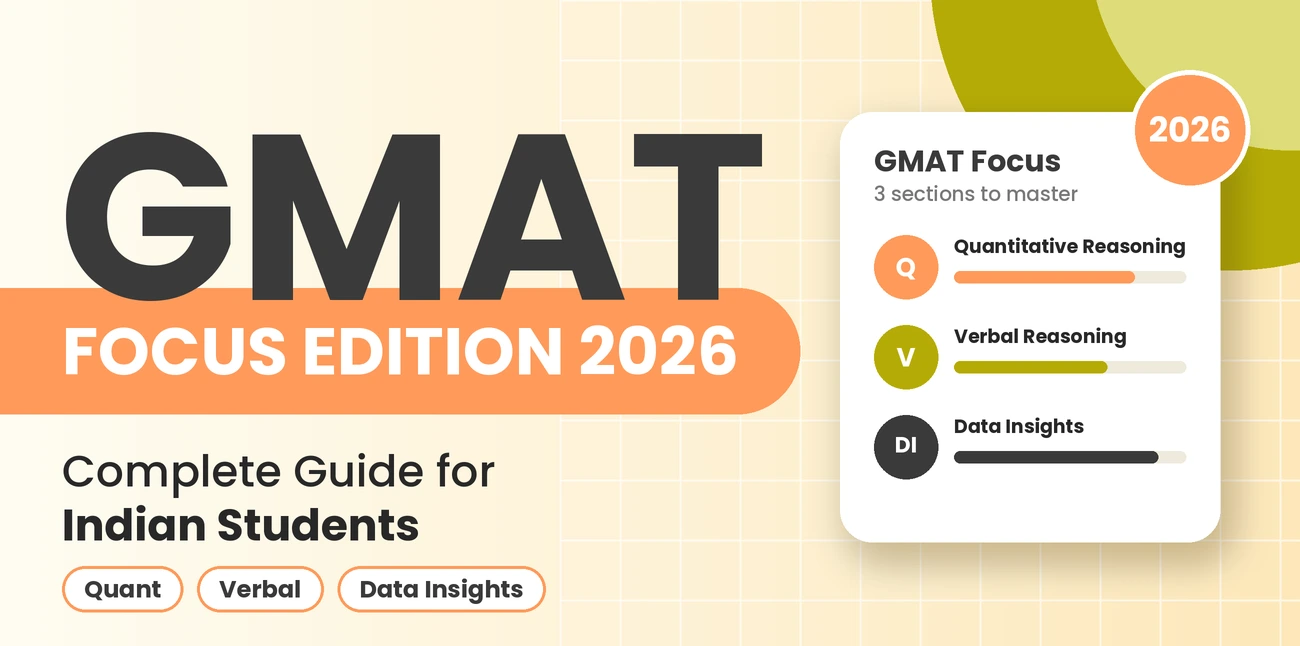
Quick Facts About the GMAT in 2026
Test length: 2 hours 15 minutes with 64 questions.
Sections: Quantitative Reasoning (21 questions), Verbal Reasoning (23 questions) and Data Insights (20 questions).
Total score: 205 to 805, in steps of 10, so every score ends in 5.
Section score: 60 to 90 for each section.
Score validity: 5 years from the test date.
Superscore: Live since 12 August 2026, and it is free.
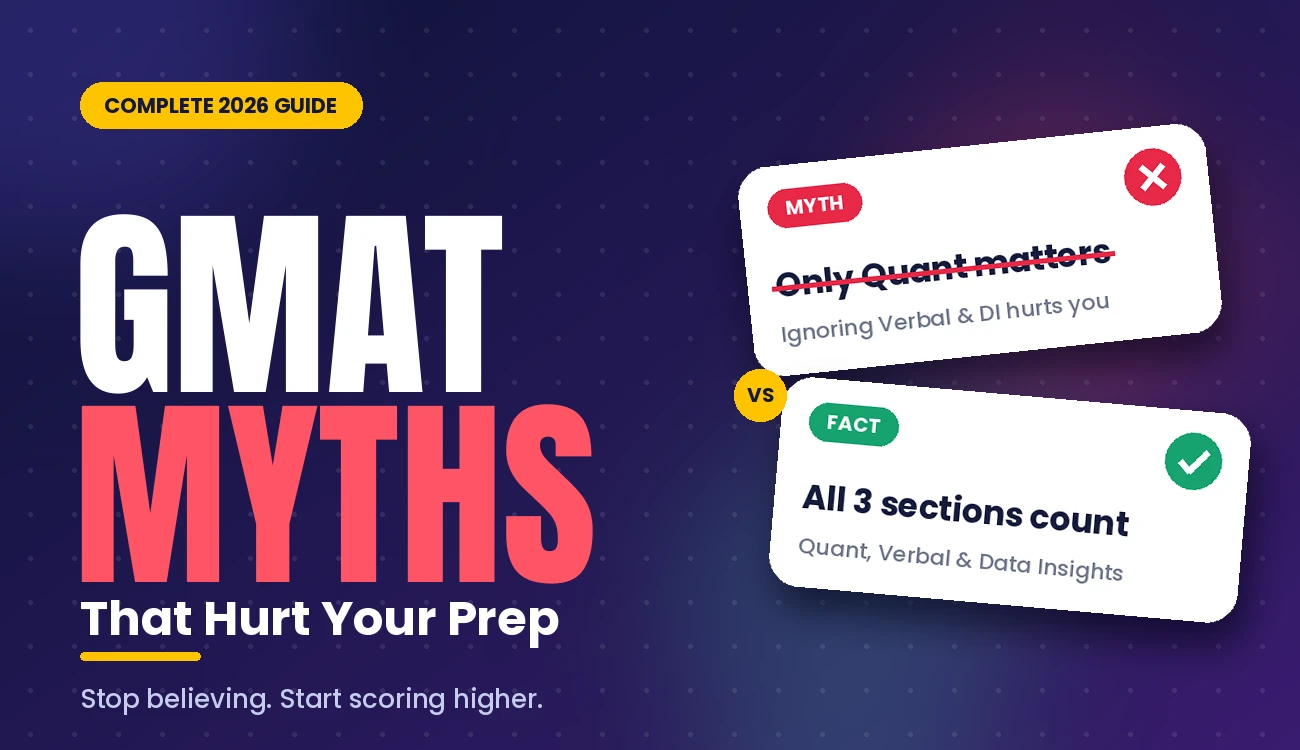
Which GMAT myths can affect your 2026 preparation?
Misconception 1: Using old material is still useful
GMAC released the Focus Edition in November 2023. Since 31 st January 2024, candidates are no longer taking the classic version of the GMAT. Although the exam is now referred to as just ‘GMAT’, the exam follows the same format of the Focus version.
Sentence Correction, the essays, and a large number of Geometry questions have been removed from the exam. Therefore, studying from old resources may mean wasting time learning topics that no longer come up. Be very careful to ensure that the resource you are using follows the current format.
To get accurate Sample Questions from the new GMAT format, use resources provided from the official website (mba.com). After using official resources, use updated books or trusted resources which clearly state they follow the ‘Focus’ format.
Misconception 2: Sentence Correction and Geometry will be key
Sentence Correction questions no longer appear within this exam. Only Reading Comprehension and Critical Reasoning have been included within the verbal section. Within the Quantitative Reasoning section, only arithmetic and algebraic questions are included. Most geometry has been removed.
Therefore, focus your study on reading, logical reasoning and simple maths skills. Students often make rapid improvements in their scores by removing these outdated topics from their revision.
Misconception 3: I need to write an Essay
The Analytical Writing Assessment has been removed. This test is now comprised of 3 sections: Quant, Verbal and Data Insights. You no longer need to revise writing essays.
Instead, the Data Insights section now replaces the Integrated Reasoning section. Within this section, you will encounter data sufficient, multi-source reasoning, table analysis, graphical interpretation and two-part analysis. Instead of spending time practicing essays, try practicing questions from this new section.
Misconception 4: Only people who are good at math should take the GMAT.
Many people from commerce and arts background may be put off by this idea. In reality, only simple arithmetic and algebra is tested in the quantitative section. Calculus and complex geometry are not required.
The verbal and Data Insights sections hold equal weighting. People with strong reading skills and logical thinking can achieve a high score regardless of them having a mathematical degree. Consistent practice is key rather than the academic background.
Misconception 5: I Cannot Review My Answers and choose the order of sections
This is no longer true. You can now choose what order to complete the three sections in. Many students will begin with their strongest section to gain confidence.
You can also place certain questions in your bookmarks, and change up to 3 answers in each section. However, you cannot skip questions in the exam. Every question must be answered to continue and therefore it is important to manage your time well.
Misconception 6: “Low Score”
As the scoring system has changed, it is recommended that you do not directly compare new GMAT scores to classic GMAT scores. If you scored 650, this would be equivalent to roughly 700 on the classic test. However, do not refer to previous score charts in order to evaluate your performance. Instead, look up the average scores from your target schools.
Can you estimate your score? You can use a GMAT Score Calculator but this is only an estimate and therefore, should not be treated as an official score. It can be used for planning purposes though.
Misconception 7: “GMAT can only be taken on certain dates”
Unlike some entrance exams, GMAT can be taken on various dates throughout the year. This depends on your chosen test center within your city.
When can I take GMAT in 2026? As the GMAT Exam Dates depend on the test center, take a look at the live date calendar on mba.com. For the best possible results, we suggest applying 2-3 months in advance.
Misconception 8: "The Fee Is the Same for Everyone and Never Changes"
The price of the GMAT depends on how you take the test. Within India, the standard price is $275 for a test center and $300 for online. GMAC also state that fees can vary.
What is the price of GMAT in India in rupees? The final price in INR will depend on currency conversion rates, bank charges and taxes. Please check the payment page on mba.com.
What is the price of GMAT if you change your exam date? If you change your exam date, it costs between $55-$180 depending on how early you make the change. Additional score reports cost $35 each.
Many people also ask what the online price of the GMAT is. As the online version involves live proctoring, the price is higher than taking the GMAT at a test centre. We recommend taking a look at the differences in price between both versions.
If taking the GMAT in India, please ensure you have a valid passport. The name on your booking must match exactly with that on your passport. Please check the most up-to-date requirements for identification at mba.com.
Misconception 9: “If I have a poor score, it means I cannot get in”
Many students may be afraid to retake the GMAT. Good news! GMAC now allow Superscoring. This means that the highest scores from the Quantitative, Verbal and Data Insights sections of multiple valid attempts can be combined to create an overall score.
This feature is free for both test centers and online tests. Classic scores cannot be included. If the same score was achieved in the same section in two different attempts, the most recent score will be used.
However, not all business schools accept superscores. Please check the policies of individual schools. You can take a maximum of 5 attempts in 12 months, with a minimum of 16 days between attempts.
Misconception 10: You should do mock tests regularly
By only doing one GMAT Mock Test close to the exam date, it may be difficult to identify problem areas. In order to make the most of your mock tests, take several throughout your revision.
To match the real test, you must complete each section within 45 mins. In addition, you cannot leave any questions. By practicing the conditions of the test, you will feel more comfortable.
On mba.com, there are free official GMAT Practice Tests. However, many coaching centers and practice platforms also provide a limited number of free tests. Be very careful to compare between these. Full GMAT Mock Test will help you build endurance and understand how well you can manage the (optional) 10-minute break.
Free Full GMAT Mock Test is reliable as long as the test has been updated to reflect the current Format, with 64 questions split into 3 sections. Avoid tests with Sentence Correction and essays.
Take free GMAT Practice Tests from official sources first. Then, you may wish to purchase some tests to get a more in-depth analysis of your results. After each test be sure to go through all errors and understand why they occurred.
Misconception 11: "Coaching Is Compulsory, or Coaching Is Useless"
Although both these statements are extreme, some people do very well simply by self-studying, whereas others benefit from structure, guidance and expert feedback. Based on self-discipline and budget, select what works best for you.
Many people in India search for GMAT Coaching. With a great tutor, you will be able to understand the new exam pattern, and will have structure in order to make progress. To determine the Best GMAT Coaching in India for you, look for coaching which covers the Focus Edition and gives clear results. Consider the following factors:
· Syllabus fits the 3-section exam.
· Tutors can explain how Data Insights are covered.
· Full practice exams with detailed analysis are given.
· Fees, times of classes and refunds are all clearly listed.
In Rajasthan, people often search for GMAT Coaching in Jaipur. To find the Best GMAT Coaching in Jaipur, visit the center, ask previous students and compare class sizes.
In Maharashtra, people often search for GMAT Coaching in Pune. There are many options in Pune, for busy people and final year students. To determine the Best GMAT Coaching in Pune, consider tutor experience and whether weekend classes are possible.
GMAT Coaching can also be found in Hyderabad. Many people in Hyderabad are working so look for flexible times. To find the Best GMAT Coaching in Hyderabad, look for flexible times and updated resources.
GMAT Coaching in Chennai is also popular in South India. To find the Best GMAT Coaching in Chennai compare the online and in person coaching to see which works best with your schedule.
Attend a GMAT Demo Class to get an idea of the teaching style and speed of the class. Can you get free demo classes? Many institutes allow free GMAT demo classes. However, only attend if you feel it is beneficial.
Which of the following is a GMAT myth that can hurt your prep?
Frequently Asked Questions
Sentence Correction, essay writing and lengthy geometry problems no longer form a part of the GMAT in 2026.
No. Simple mathematical and algebraic knowledge, reading ability, logical reasoning, and data skills are tested.
Yes. Using official GMAT resources, practice questions and practice tests will be sufficient.
Yes. You can use the ‘bookmark’ feature and make changes to a maximum of 3 answers in each section.
Yes. If a candidate has made multiple valid attempts at the GMAT they can choose to get the best score in each section. Unfortunately, not all business schools allow this.
Find Out Where Your GMAT Score Stands Today
Enter your section scores, see your total in seconds, and know how far you are from your target.
A study plan to get good GMAT score in 2026 -
Take a diagnostic quiz to determine your starting point.
Only use up-to-date materials. Choose materials that follow the 3-section structure (64 questions).
Each week, complete questions from all 3 sections.
Focus extra time on the section in which you are weakest. Regularly revise the sections in which you are strongest.
Time each section. You should aim to complete them in 45 minutes.
Every 2 weeks take a full practice test. Ensure that you go through all of your errors before taking the next test.
Ensure that the score you get in each test is consistent. Once you have got a consistent score in 3 tests, book your test.
Check all information on mba.com. Check the cost, times and ID requirements.
Conclusion
It is important to prepare regularly with a strategy to perform well on the GMAT 2026 exam. If you have incorrect notions about GMAT, like thinking that you need to be an expert in Mathematics, or, that you need to study for extended periods of time and answer all questions correctly, it may impact your preparation. Here are 5 misconceptions about GMAT you should know. Understand the GMAT Focus Edition by clicking here, improve your Quantitative Reasoning, Verbal Reasoning, and Data Insights, and attempt mock tests from official GMAT resources. Make a feasible GMAT study timetable. Focus on improving your weak areas and keep monitor your progress regularly. Achieve a high score in the GMAT by preparing smartly. So, take guidance from trusted GMAT sources and do a consistent prep and you can boost your performance and get into your preferred business school.
Frequently Asked Questions
It is a myth that you can use old resources. Since the pattern, section types and scoring systems have changed, it is always best to use updated resources.
No. There are 3 sections: Quantitative Reasoning, Verbal Reasoning and Data Insights.
Yes. However, you may change your answers (up to three) in each section, after you have marked questions.
No. Please make sure that it is accepted at each college which you are considering.
They are valid for 5 years from the date of taking the exam.
$275 for In-person exams and $300 for Online. The final amount of money depends on taxes, bank fees and currency conversion, so please check mba.com for accurate information.
No. Depending on your location and test center, you can take the exam at various points in the year. We recommend booking 2 to 3 months in advance to secure your desired time.
Once every 16 days. However, in a rolling 12-month period, you may only take the test 5 times.
Know the GMAT Before You Plan Your Prep
Sections, scoring, timing and registration, all explained simply so you can start your preparation with a clear picture.