



Many students aiming to pursue an MBA in 2026 are getting confused due to old resources (blogs, videos, etc.). The new GMAT Focus Edition has significant changes in exam pattern, sections, scoring, and strategy. Therefore, it is important for students to understand what changes have been made in the 2026 edition in order to get admissions in top b-schools in India and Abroad. If you are preparing for the GMAT for the first time, or if you are updating your preparation plan, this article will cover the latest changes in the GMAT Focus Edition (GMAT exam pattern, syllabus, scoring, fee structure, and preparation strategies.
What is GMAT Focus Edition?
The GMAT Focus Edition was launched by the Graduate Management Admission Council (GMAC) in November 2023. There were major changes in exam pattern, sections, scoring and test duration. The classical GMAT was discontinued from 31st January, 2024, and the redesigned GMAT became the standard test for all students. However, in GMAT 2026, the exam is referred to simply as ‘GMAT’.
Even though the name of the exam is changed, the structure of the exam under the GMAT Focus Edition holds true. Hence, if you are preparing for the GMAT exam in 2026, you can refer to the Focus Edition resources as long as they have updated information. While applying to b-schools, it is important to note that the exam must be referred to as ‘GMAT’. This will avoid any confusion for Indian students while understanding the GMAT preparation process, registration process and requirements for MBA admissions.
Understand the GMAT Exam Before You Start Preparing
Learn the format, sections, and scoring so your preparation starts in the right direction. Ooshas Prep explains it all in simple steps.
GMAT Focus Edition vs Classic GMAT: Quick Comparison
| Feature | Classic GMAT (Retired) | Current GMAT (Focus Edition) |
|---|---|---|
| Test Length | About 3 hours 7 minutes | 2 hours 15 minutes |
| Sections | Quant, Verbal, Integrated Reasoning, Essay | Quant, Verbal, Data Insights |
| Total Questions | 80 | 64 |
| Score Range | 200–800 | 205–805 |
| Essay (AWA) | Yes | No |
| Sentence Correction | Yes | Removed |
| Geometry | Yes | Mostly Removed |
| Answer Review | Not Allowed | Bookmark and edit up to 3 answers per section |
Key changes in GMAT Focus Edition
- Shorter duration: The GMAT Focus Edition lasts 2h15m, and has 64 questions. Therefore, it has reduced in length by approximately 1h compared to the original version. The duration of each section is 45 minutes, and the questions will be adaptive to the candidates’ performance.
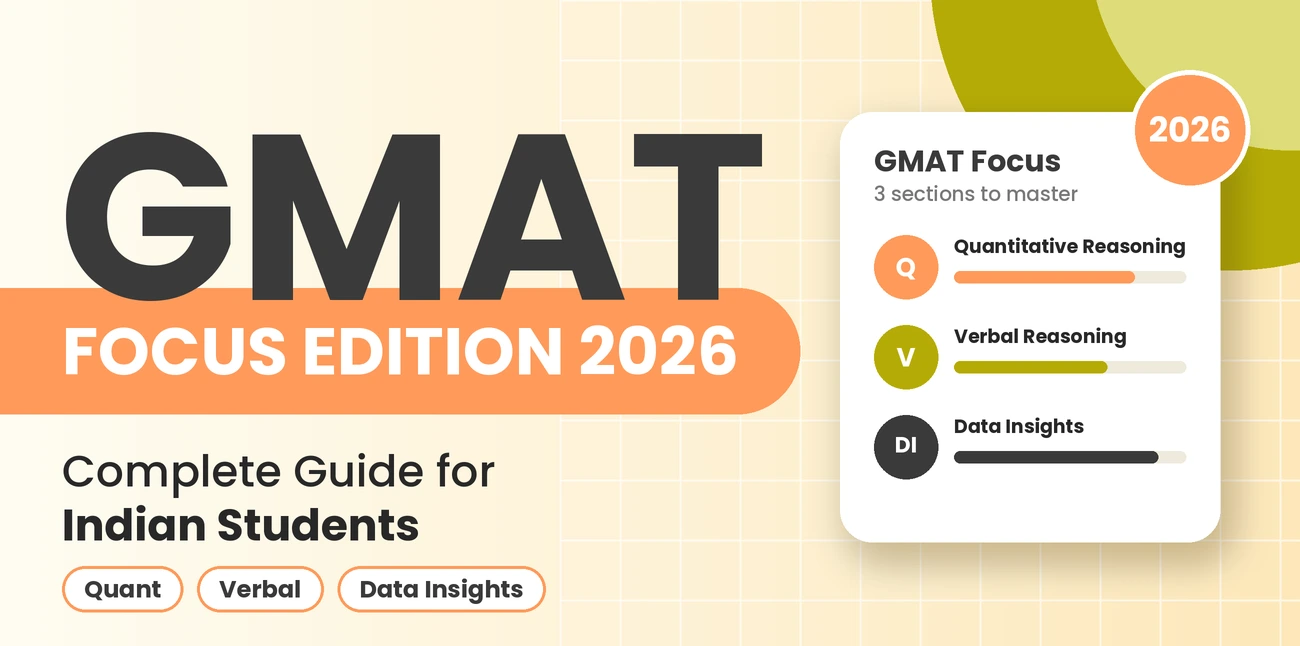
- 3 sections only: There is no writing section. There are 21 questions in Quantitative Reasoning, 23 in Verbal Reasoning and 20 in Data Insights. The Quantitative Reasoning section tests arithmetic and algebraic skills. Most of the geometry has been removed from this section. The Verbal Reasoning section consists of reading comprehension and critical reasoning. Since sentence correction has been removed, this section no longer contains sentence correction. Data Insights, replacing Integrated Reasoning, consists of data sufficiency, multi-source reasoning, table analysis, graphics interpretation and 2-part analysis.
- Flexibility in test- Within the test, candidates can choose the order they want to complete the 3 sections in. This can allow candidates to complete their strongest section first to gain confidence. Within the test there is also 1 optional break of 10 minutes. You should decide how you wish to use this break ahead of the test. During the test, you can make notes (bookmarks) using the question review and edit facility. At the end of each section, you can review these questions, and may change up to 3 of your answers. However, you cannot skip questions. You must answer each question before moving to the next. Be sure to pace yourself well within the test.
Which of these is no longer part of the GMAT Focus Edition?
How does GMAT scoring work now, and can a GMAT score calculator help?
The GMAT Scoring System for 2026 has changed. The key details candidates should be aware of are below:
- Total GMAT Score: Overall score ranges from 205 to 805. Increases in increments of 10. All scores end in 5.
- Section Based Score: Quantitative Reasoning, Verbal Reasoning and Data Insights sections have scores from 60 to 90, and increase in increments of 1.
- Comparing new and old GMAT scores: Scores on the new GMAT should not be directly compared to scores on the old GMAT. For example, obtaining a score of 650 on the new GMAT is approximately equivalent to obtaining a score of 700 on the old GMAT.
- GMAT Score Calculators: Using a GMAT score calculator will give you an approximate total score, based on your section scores. It is not an official score.https://www.ooshasprep.com/blog/gmat-focus-edition-scoring
- GMAT Score Validity: Official GMAT scores are valid for 5 years from taking the test.
What is the total score range of the GMAT Focus Edition?
Check Your GMAT Score in Seconds
Enter your section performance and get an estimated score. Use it to see where you stand and what to improve next.
What is GMAT Superscore, the Biggest 2026 Update?
- GMAT Super Scoring- One of the major changes made by GMAC in 2026 is GMAT Super Scoring. Below are some key points to consider for Indian applicants.
- New Feature Launched in 2026- The feature was announced in June 2026. It was implemented and added to the system on 12 August 2026.
- How it works- Your best Quantitative Reasoning, Verbal Reasoning, and Data Insights scores from multiple valid tests will be combined to provide an overall score between 205 and 805.
- No Extra Charge- There is no charge to create a GMAT Superscore.
- Test Centre & Online- Tests taken at GMAT test centres and online are eligible.
- Valid Tests Only- Only current valid tests (new version) will count towards your GMAT Superscore. GMAT Classic tests are not counted.
- Linked Scores- In the case that you have tied scores in the same section in two attempts, the latest will be selected.
- Score Reports Prior to 12 August 2026- Score reports sent to business schools prior to 12 August 2026 will not show this new superscore. To provide an updated score report, a new score report needs to be sent.
- Limited-time Free Score Reports- Some candidates may see a limited-time offer for 5 free score reports. To check what is available to you please log into mba.com.
- Not Acceptable at all universities- It is not acceptable at all universities/ business schools. Before taking multiple tests, check to see what score requirements are required for the GMAT at your target universities and whether they accept GMAT Superscores.
Frequently Asked Questions
The new GMAT was launched in November 2023. In 2026, it will be called the GMAT.
Shorter (2h 15m). Now only 3 sections: quantitative, verbal and Data Insights. Essay, Sentence Correction and most geometry have been removed.
The overall score is between 205 and 805 (always ends with a 5). The individual section scores range between 60 and 90. Score is valid for 5 years.
You can combine your highest scoring sections from multiple valid tests to make an overall score. This is free. Available from 12th August 2026.
No. Check the policies of the business schools you are applying to.
GMAT Exam Fees India (2026)
Candidates in India can take either the computer based or online format of the GMAT exam. For the Computer Based format the fee is $275 and for Online format is $300. However, since candidates in India have to pay 18% tax (GST) on the GMAT exam the total cost becomes approximately $324.50 for Computer Based and $354.00 for Online.
Depending on exchange rates in April 2026 the total cost of GMAT Exam in India is approximately INR 30,200 for Computer Based and INR 33,000 for Online. A common question asked by students is about the rescheduling fees of the GMAT Exam. The prices below exclude tax:
| When You Reschedule | Test Center Fee | Online Fee |
|---|---|---|
| More than 60 days before the | US$55 | US$60 |
| 15 to 60 days before the exam | US$110 | US$120 |
| 14 days or less before the exam | US$165 | US$180 |
You can get a maximum of 5 free reports. Each additional report costs $35. However, please make sure that you check your total cost on the checkout page of mba.com, as prices and taxes may change.
GMAT Dates 2026:
As there are no set dates for everyone in the country, you can sit your GMAT in a Test Centre or Online. Therefore, depending on location, the available GMAT Dates 2026 will be reliant on available spaces. We recommend booking early, as spaces may run out before deadlines at your preferred Test Centre. If retaking, we recommend waiting at least 16 days. You can sit this test a maximum of 5 times within a rolling 12-month period.
How should you prepare for GMAT Sample Questions, Mock Tests and Practice?
Try some Sample Questions for each section first so that you are familiar with the new question styles. Try a Practice Test so that you get a baseline score and see your areas of weakness.
Free GMAT Practice Test
Start with Official GMAT practice on mba.com. Add in other free practice tests from reputable providers. After completing the foundations of the test, try a full-length GMAT Practice Test to ensure that you can maintain concentration over 2 hours and 15 minutes.
A Free Full-length GMAT Practice Test will allow you to see whether you can complete each section (45 minutes each) well, particularly the Data Insights section. Try a Free GMAT Practice Test every week. For every error, note it in a notebook with the reason for the error.
By doing regular GMAT Practice Tests, you will become familiar with using the Question Review and Edit function. You can only change 3 answers within each section. We would not recommend studying Sentence Correction, writing practice or heavily geometric topics as none of these topics appear in the current test.
Which is the best GMAT Coaching in India and how you can choose coaching’s in your city?
When choosing a coaching institute for the GMAT Coaching in India, make sure that they follow the current format of the test with 3 sections. A good institute will have:
Qualified faculty
Training for Data Insights (No Grammar correction)
Adaptive practice tests that give a detailed breakup of scores
Few students in small batches so that your doubts can be addressed properly.
Also consider the price and time constraints. Go to a few free sessions and compare the fee structure. Inquire about actual results from students. Just seeing rankings may not help much.
Best city to look for:
Jaipur
Check out the timings in weekday/weekend batches. Go to 2-3 free sessions in order to understand what the teaching methodology is like, the study material and practice tests. If you are looking for GMAT Coaching in Jaipur, going to free sessions in different institutes will give you more information than brochures.
Pune
Check out timings of batches and also ensure that the study material has been updated for the latest pattern.
Hyderabad
Check out the profile of faculty members, timings of batches and demo sessions. Narrow down to 2-3 institutes. Choose an institute that can get you to your target score.
Chennai
Check if the classes are online/offline/both. Ensure that the material is updated and that a proper report is provided after every practice test.
If you cannot attend physical classes, you can go for online GMAT Coaching. However, ensure that you are getting good practice tests and doubt assistance.
GMAT Coaching in India That Fits Your Goals
Learn with experienced mentors, adaptive mock tests and small batches. Ooshas Prep helps you prepare smarter, online or at your own pace.
Is Demo Class available?
Check out the Demo Class of GMAT trainers to get an idea about their teaching quality. Make sure that the Demo Class follows the 2026 pattern. Some institutes also give free demo classes. Hence, confirm the same before registration.
Conclusion-
If you are an Indian student aspiring to take up MBA program, then the changes in the test pattern of GMAT cannot be ignored. The changes in test pattern, scoring and variety of questions as GMAT Superscore, have affected the approach of appearing for the test and scoring for the students. Although the GMAT Focus Edition has become the standard GMAT, even it follows the new pattern. In order to prepare well, students should know the pattern of GMAT, syllabus, scoring in each section, examination fee and validity of the scores. A good score is possible with proper preparation, practice through mock tests and time management. However, do not forget to know about all the requirements of the business school before applying. With proper knowledge and planning, you can be assured of success.
Frequently Asked Questions
GMAT Focus Edition has been replaced by GMAT. However, the new pattern of the exam is in effect.
The range of total score in GMAT is 205 to 805.
The GMAT contains three sections: Quantitative Reasoning, Verbal Reasoning and Data Insights.
Official GMAT scores are valid for 5 years.
The GMAT superscore is calculated using the best section scores from qualifying attempts.
Yes! Eligible Indian students can take this exam either in online mode or at an approved test centre.
This depends on your quantitative ability, verbal and analytical ability. Hence, there is no definite answer to this question.
Know the exam syllabus, solve section wise questions, take mock tests and follow regular study pattern.