Planning to write the GMAT this year? Then it is most likely that you have already heard the news about an upcoming change regarding the GMAT's score range or a new section named Data Insights. While this is all very interesting, it may sound like Greek to someone unfamiliar with the scoring system of the GMAT.
Through this ultimate guide section, you will learn everything there is to know about the GMAT Focus Edition's scoring structure in 2026. We will go over the new score range, each section's calculation method, a good score, and much more.
What changes have been made in the GMAT Scoring System?
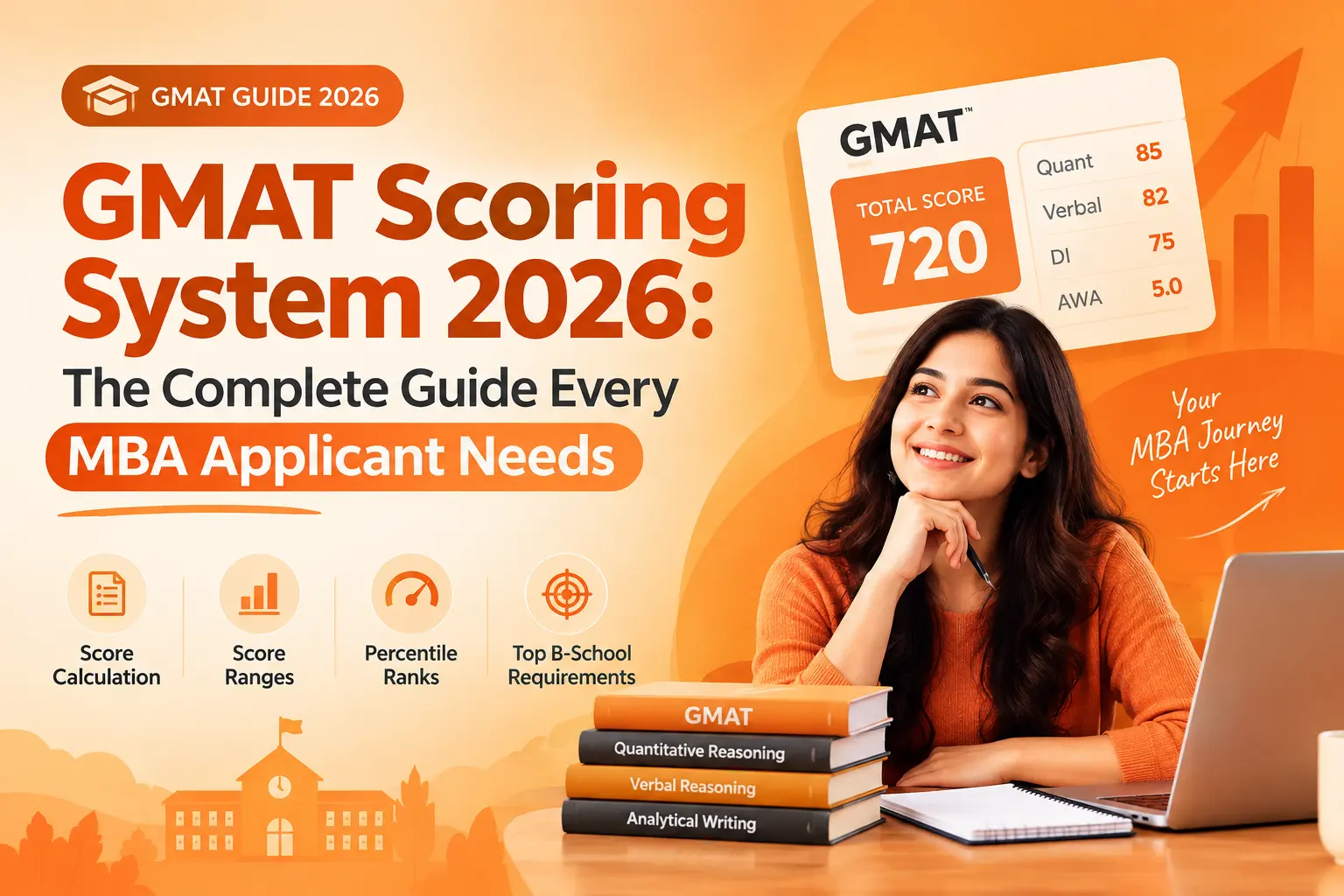
GMAT Focus Edition is the latest addition. Scores vary between a low of 205 and a high of 805 in 10 point increments. This means that you will receive scores of 605, 655, 705, 755, rather than 650 or 700.
What prompted GMAC to change the scoring scheme?
GMAT chose to repurposed the scoring convention to help admission teams effortlessly differentiate between the old and the new scores. For example, if one receives a score of 655, there will be no ambiguity on the fact that it was scored using the new GMAT test. In contrast, a score of 650 will instantly be ruled out to be from the previous GMAT test.
How long is the new test?
The new GMAT Focus Edition Exam lasts 2 hours and 15 minutes. This is compared to more than 3 hours for the previous standard GMAT. The change was suggested since the shorter test is more refreshing and allows test-takers to remain sharp through the last stages of the exam. check out our complete GMAT Exam 2026 guide —
What are the three sections that contribute to your overall score?
The GMAT Focus Edition test has done away with the Analytical Writing Assessment entirely. Moreover, Sentence Correction questions are no longer present. Instead, test-takers are confronted with three sections that contribute equally to the final grade:
- Quantitative Reasoning
- Verbal Reasoning
- Data Insights
Each is graded on a scale ranging from 60 to 90. It is important to note that all the three carry equal weight in determining the overall score. The score will therefore not be given greater weight on either side. Therefore, a poor score on quantitative reasoning will affect the average as much as a poor verbal reasoning score.
The updated GMAT structure is quite different from the previous one as it no longer contains Integrated Reasoning and Analytical Writing sections. They only served as separate scores before, with the main focus on the total. However, business schools have shown little interest in the essays and integrated reasoning, and they are now gone. Data Insights is the new integrated reasoning, but it is now weighted the same as the other two sections.
- Quantitative Reasoning- This part tests your reasoning skills. There are fewer geometry-related problems, as many of them were eliminated due to the redesign. More emphasis is put on algebra, arithmetic, and word problems in the 21 questions per session during the 45-minute session.
- Verbal Reasoning- Reading Comprehension and Critical Reasoning have taken the place of Sentence Correction. Most non-native English speakers will be happy to hear that there is no need to worry about grammar anymore. The 23 questions in the 45-minute time frame still test logic and comprehension.
- Data Insights- This part is a mix of some question types from the previous Integrated Reasoning. This involves graph and table interpretation, multi-source reasoning, and two-part analysis questions. There is a greater focus on problem solving and it takes 45 minutes with 20 questions overall.
How is the total GMAT score calculated?
Unlike the simple average score calculated from the three sections, your total GMAT score is not a straightforward one. The GMAT utilises a complex algorithm which takes into account your results in the Verbal, Quantitative Aptitude and the Data Insights section and then combines them to give you a score between 205 and 805. This algorithm is not completely revealed, but it has been discovered that all three sections hold equal weight in the calculation. More Details GMAT Score calculated information
How does the computer adapt the difficulty of the questions based on your performance?
Computer Adaptive Testing is used to determine the level of difficulty of the questions. In other words, if you give the correct response to a difficult question, then the next question will be slightly difficult for you; but if you make mistakes with an easy question, then you will get another easy question. You cannot go back and change your answer because the test is self-advancing.
Does the GMAT allow me to skip a few questions?
No, you are not allowed to leave any question attempted because, on GMAT, you have to attempt the questions in one section before moving onto the other section. But what the test-maker has made possible is that the test-taker should be able to check the questions which he finds more suitable for him. During attempting the questions, you can flag them, and then at the end of attempting all the questions, you can go back to the review screen and make changes in your answers.
GMAT Score Chart: What the Numbers Actually Mean
The figures do not paint the whole picture. What is truly significant is your percentile score, because that will precisely inform admissions committees of your standing among all other test takers. The following is a rough guide to how Focus Edition scores translate to percentiles in 2026:
| Total Score | Approximate Percentile | How It's Viewed |
|---|---|---|
| 555–595 | 60th–75th | Below average for top programs |
| 605–635 | 75th–85th | Competitive for mid-tier programs |
| 645 | ~88th | Widely seen as the benchmark “good” score |
| 655–695 | 90th–97th | Strong, well above average |
| 705 and above | 99th | Excellent, elite-tier score |
A 645 receives much consideration, as it is the figure that GMAC itself has confirmed to be almost equivalent to the 700 of the traditional scale. In case you have been through GMAT preparation culture in the past few years, then you would know that the target was always 700. And now 645 is the new 700.
Percentiles are not fixed forever, though. They are recalculated each year in light of how well the overall group of people taking the exam did. Your percentile may move up a little or down a little bit. However, your actual score might remain the same.
Explore Complete GMAT Exam Details 2026
Scoring is just one piece of the puzzle. Get complete GMAT exam details — pattern, syllabus, registration steps, fees, and 2026 exam dates — before you book your slot.
What counts as a good GMAT Score in 2026?
In fact, there is no good or bad score. Everything depends on the university and the program you are going to apply to. The same score can be good enough for one college, while for another one it can be just a medium.
That said, here is a practical way to think about it:
- 700–750+: This range fits M7 schools like Harvard, Stanford, Wharton, and Kellogg. Their median scores for enrolled students usually sit somewhere in this band.
- 650–700: Solid for T25 programs and many strong regional business schools.
- 645 and above: A safe, competitive baseline for most global MBA programs.
- Below 600: Still usable for certain programs, especially when paired with strong work experience or a compelling application story.
While scores are indeed important, they rarely paint the entire picture. In fact, the admissions committee is fully prepared to take into consideration your application paper, recommendation, and work experience in the field into account. Forthwith, a test score of 705 but a poor application form will never win against the one with a 650 but an exceptional story behind it.
GMAT Focus vs Classic GMAT: Score Conversion
A A lot of applicants still cling to old GMAT scores. Good news! Scores are valid for 5 years from the test date, so they should still be acceptable for the current admissions cycle.
But comparing a classic score to a Focus Edition score takes a little translation. The scales do not match up one to one. Roughly speaking:
- A Focus score of 645 lines up with a classic 700
- A Focus score of 685 lines up with a classic 740
- A Focus score of 705 lines up with a classic 750
If you already hold a classic GMAT score and you are wondering whether to retake the exam under the new format, run your number through a conversion table first.
What Would You Score Right Now?
Don't just read about score ranges — see your own. Enter your practice test results into our GMAT Score Calculator and get an instant estimate of your total score and percentile.
The Adaptive Algorithm Explained Essay
Many test takers are concerned with how the test knows how hard or easy the questions should be. Basically, the test is constantly analyzing your accuracy on a certain level of difficulty and adjusting the next question accordingly. Getting an answer right will prompt the algorithm to raise the difficulty and subsequently your potential score. At the same time, getting questions wrong will lower the difficulty slightly to assess your true level of understanding.
This translates to the fact that the tests for any two test takers are not likely to be the same, even if the two sit for the exam at the same time. It thus becomes difficult to compare answers from other people and assess one’s performance. Every test taker experiences their own unique exam.
One thing to note is that earlier questions in a particular section are slightly worth more than later questions. This does not mean you shouldn't be concerned about the first few questions but rather that you should strive to be calm and focused and do well on these important questions.
How to read your GMAT score report?
Your score report includes the following:
- Total score – Main score of the exam that ranges between 205 – 805.
- Scores for each section – The score for each section and subsection, including Data Insights, Verbal, and Quantitative sections, ranges between 60 – 90.
- Percentile ranking – Your percentile ranking indicating how well you have performed compared to other test-takers for both the overall score and each section.
- Enhanced score report – The score report is an in-depth analysis of the test-taker’s performance. This report is essential to understand where you need more practice and can be used to determine your score on resubmissions.
The enhanced score report is an additional feature that comes with your registration and is available to everyone. The report is an excellent tool that indicates your performance on time management, types of questions, and overall performance in each section. The information will help you identify your problem areas and the sections that require more attention.
Preparation Tips Based on the Scoring Structure
Since all three sections are equal in terms of their weight, your preparation plan should also be well-balanced. However, many students tend to study the quantitative section more than the other two, just because they are used to it. Such a biased plan is less effective and could be easily improved. Several pieces of advice on this topic can be summarised in the points mentioned below:
- First of all, take a diagnostic test to know your starting position. It is unwise to begin your preparation for the GRE without having a strategic vision about your current skills. In fact, without honest self-analysis, you will lack motivation to prepare for the test;
- Next, try to prepare for Data Insights more seriously, as many say that it is an underestimated challenge. This section is new, and some students often neglect it due to its strangeness, but it is fully scored;
- Try to imitate the test results, taking into account the time limits of each part. Every section of the test must be done in 45 minutes. In this way, you will be able to find your own approach to fast and effective task completion.
- Check your mistakes and try not to make them in the future. But do not forget about those situations when you can make the correct guess, although you don’t know the subject properly enough;
- Some students prefer to start working on the easiest section first, in order to gain self-confidence. Since it is allowed to choose the order of the sections, think about this strategy and try it during your preparation.
What is the common mistakes test-takers make in respect to GMAT scoring?
- Ignoring all three sections- many test-takers focus on one section more than the others, which is not helpful, as all three sections contribute towards the total score.
- Treating the scores as simple addition- The total score is not a simple sum of the three section scores. GMAT score uses a GMAT algorithm which combines the three section scores to give the final score.
- Focusing only on accuracy- It is true that accuracy is important, but one should also keep track of time while solving questions. Spending much time on some questions will impact the score adversely. So, accuracy and time management should be taken care of.
- Mistaken score range- Sometimes there is confusion between section scores and total score. One should be aware of the scoring range to be able to achieve the desired score.
- Neglecting Data Insights- Many times it is seen that students focus on achieving good scores in other sections and take insights for granted. But Data Insights is one of the three sections for which the score is calculated.
GMAT Scoring and Business School Expectations in 2026
- The best universities have already adjusted their expectations in line with the new standard. In terms of GMAT, M7 school representatives are looking for scores around 700-750+, while T25 universities expect around 650-700. As for regional and executive programs, including many prestigious Indian business schools, they set the bar a bit higher: 645-685.
- One should also note that GMAT scores are valid for five years, so a high result can be used to apply multiple times, even if a business school candidate has some time to prepare for the next selection rounds.
Want Expert Guidance Instead of Studying Alone?
Scoring well on the Focus Edition takes structured practice across all three sections. If self-study feels overwhelming, explore GMAT coaching in India for live classes, mock tests, and expert feedback tailored to your target score.
Conclusion on the GMAT Scoring System
The GMAT scoring system in 2026 is based on the test taker’s performance on the Quantitative Reasoning, Verbal Reasoning, and Data Insights sections. As such, in order to secure a high Total Score, it is essential to perform well on all three parts of the exam. Additionally, it is essential to understand the scoring system in order to determine your desired score depending on your percentile and the specific requirements of the business schools you are interested in.
In that regard, a comprehensive preparation strategy should be developed that would allow you to master all three sections within a certain timeframe. It may be useful for you to refer to the table above that shows the probability of obtaining a certain GMAT score in order to set real expectations. Though getting a high GMAT score is one of the key elements of your MBA application, other factors such as your academic background, work experience, letters of recommendation, and a personal statement are no less important. Generally, knowing all the details of the scoring system will help you to prepare for the test successfully.
Frequently Asked Questions
The GMAT total score lies between 205 and 805.
Three sections are considered to calculate the GMAT Total score, these are- Quantitative Reasoning, verbal reasoning and the Data Insights.
Yes, all the three sections are important as they are considered for the GMAT Total Score.
The GMAT Total Score is not calculated by simply adding up the scores of all the sections, an algorithm is used to calculate the total score.
Data Insights is one of the sections which are considered for calculating the GMAT Total Score; thus, it does have an impact on the total score.
Both accuracy and speed are important, however, one must focus on accuracy while maintaining a good speed, as the GMAT is a timed test.
Yes, one must prepare for each section of the GMAT test equally, as all the sections carry equal weightage.
One should select a score to aim for the GMAT, based upon the target colleges and universities one wishes to apply to and the GMAT score percentile they are looking to achieve.
No, one cannot get into a B-School only by scoring well on the GMAT. Other factors like academic transcripts, work experience and performance in other rounds of the selection process also matter.
To prepare to score well on the GMAT, one must have a well-structured study plan and adhere to it religiously. Besides, one must also work on improving accuracy and speed while practising.