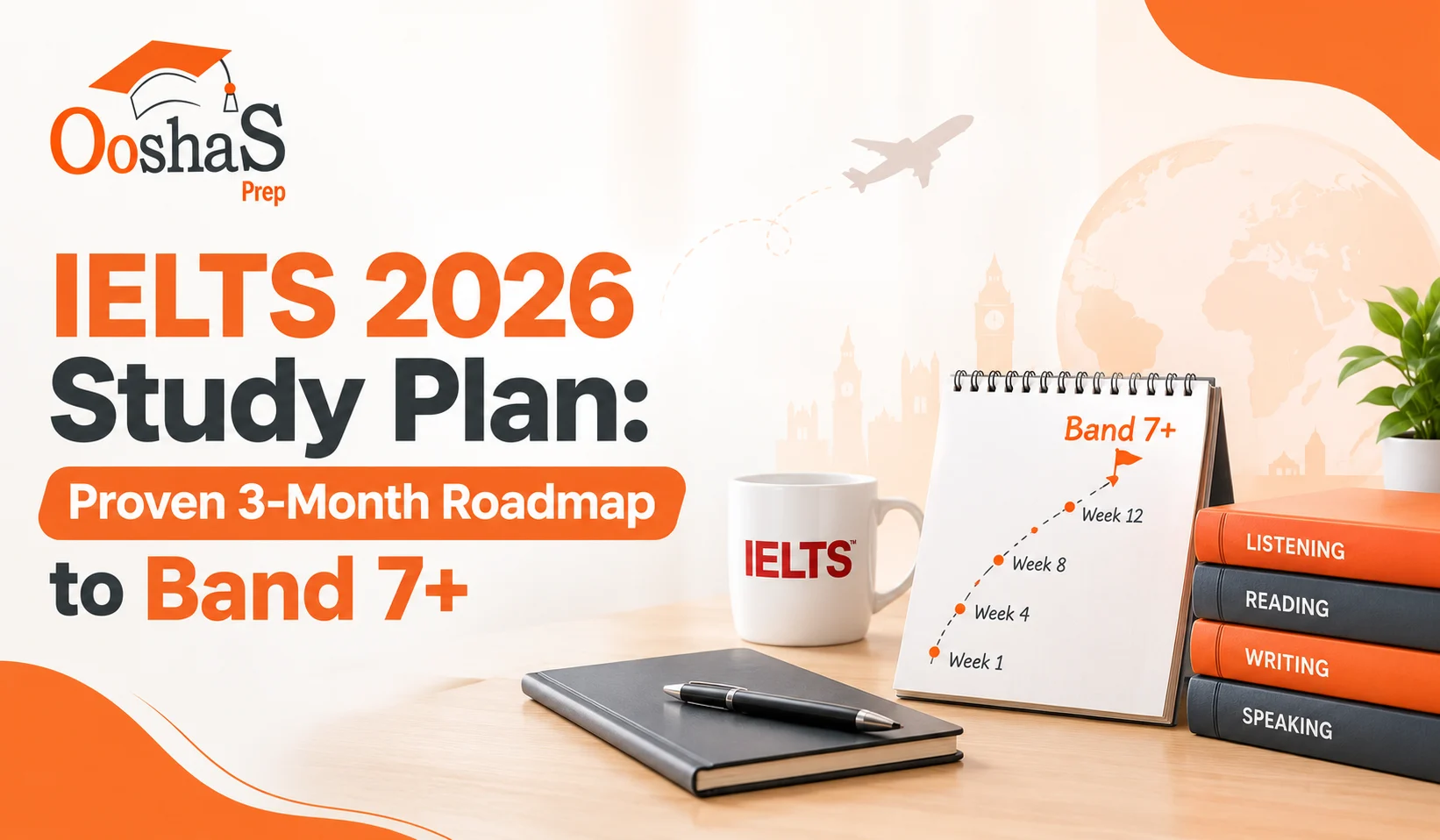
A 3 month IELTS study plan will guide you in preparing for Listening, Reading, Writing and Speaking. This IELTS study plan for 2026 is divided into 12 weeks, starting by learning the basics and moving on to taking full-length mock tests and getting ready for the final exam. This IELTS preparation plan will help you whether you are just starting your IELTS journey or preparing for a Band 7 or higher. It will also help you organize your day-to-day study and highlight the areas you need to focus on.
However, a lot of test centers still conduct them, and the pattern of IELTS, including Listening, Reading, Writing, and Speaking, remains the same. What has changed is your preparation strategy, mode of answering the questions, and how the examiners assess your answers based on your command of language and communication skills instead of rote answers. This ultimate guide is a detailed 3-month IELTS preparation plan that will help you cover everything, right from the beginning to the end, in depth.
Why 3-Month IELTS Study plan important?
When you study randomly, sometimes you may study a particular module for two days in a row, and then leave it for a week. However, when you have a proper plan, it would help you in getting your concepts cleared in all the sections one by one, preparing you for an actual test environment. A span of 3 months is just perfect for someone who wants to achieve a good score in the IELTS, without leaving any scope for improvement.
It will help you work on your grammar and vocabulary to a great extent, and since the new pattern of IELTS 2026 has been recently introduced, this preparation plan would help you get a good grasp of all the changes that have taken place. Also, most test takers who score more than a 7-band in IELTS have this one common thing in hand - a structured study plan.
Something that you must know about the IELTS exam is that it does not test your intellectual quotient; rather, it assesses your language and communication skills. Therefore, 3 months is not a long time to improve your vocabulary and grammar. Still, it is more important to practice your speaking and writing within the word limit, since the new examiners in 2026 are trained to identify robotic answers and give low scores to them.
Common IELTS exam pattern and test syllabus?
First you start for ielts preparation you must know about exam pattern and syllabus, To begin with, most testing centers now provide a computer-based test, and paper-based exams are becoming less common; however, there is also a “Writing on Paper” option available in selected locations for those who want to experience the classic mode of testing. If you decide to go for the computer-based test, make sure to practice typing your writing responses beforehand – this skill is not as superfluous as it might seem! The computer-based exam remains divided into the same four parts as ever: Listening, Reading, Writing, and Speaking.
Listening and Reading sections take 30 and 60 minutes respectively, while Writing and Speaking last around 60 and 11-14 minutes. There is no penalty for wrong answers, so it is vital to respond to every single question. As usual, scores per section are whole numbers from 0 to 9, with an average of all four parts being your final IELTS score.
