IELTS Syllabus 2026 – Complete Guide to Exam Pattern and Preparation
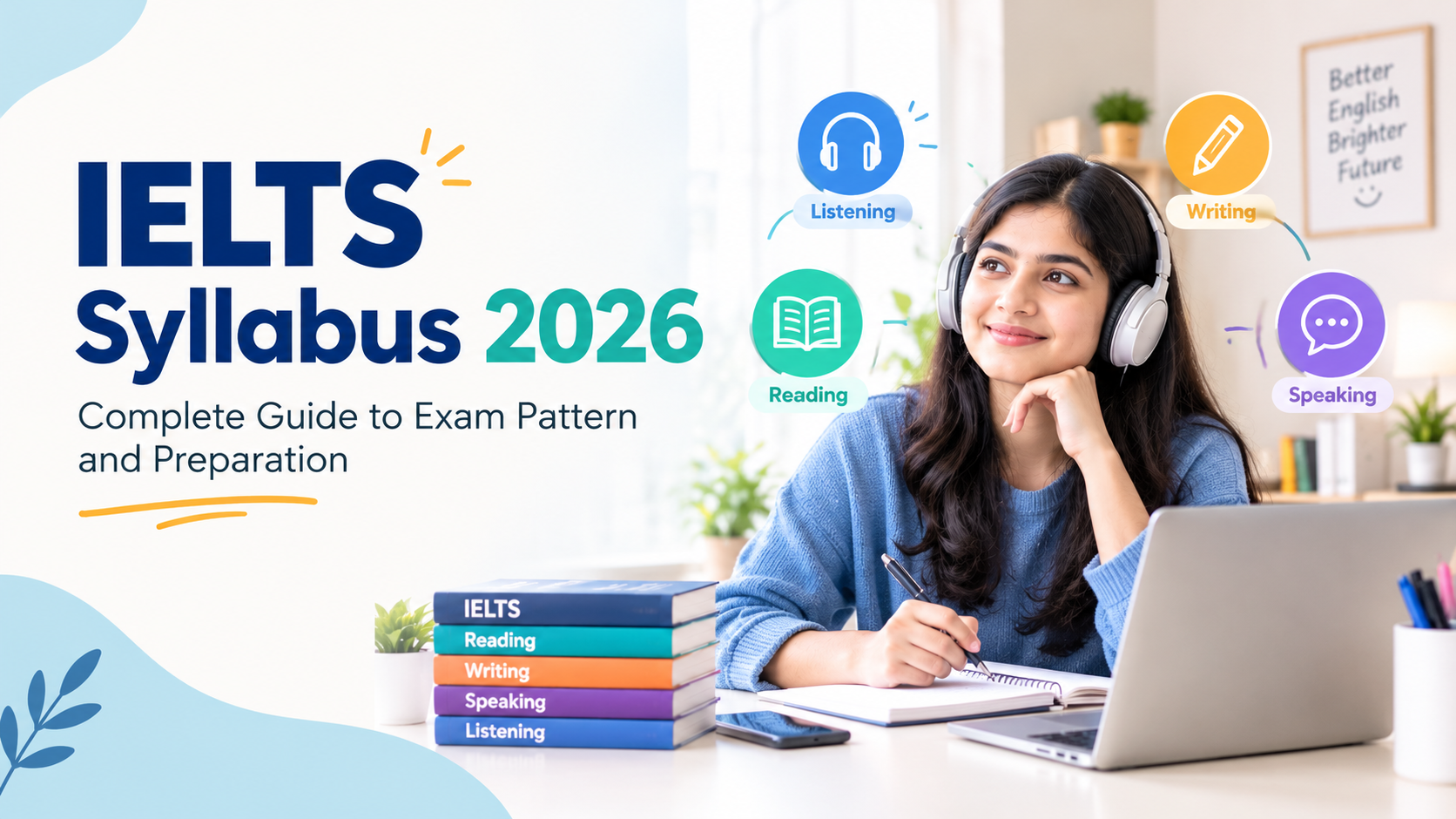
Explore the IELTS Syllabus 2026 with a complete overview of the Listening, Reading, Writing, and Speaking sections. Understand the exam pattern, question types, and preparation tips to build confidence and prepare effectively for your IELTS test.
Why the IELTS syllabus matters
Many students begin IELTS preparation by watching random videos and solving random papers. A few weeks later, they realise they’ve been practising the wrong things.
The knowledge of IELTS syllabus will enable one to get an idea of what will be expected in each of the sections, its duration, and how the scores will be awarded. This means no more guessing, and you can plan your revision.
This guide will walk you through the complete IELTS exam syllabus, whether you are taking the test for the first time or retaking it to get a higher band score.
Complete IELTS Syllabus 2026
The IELTS exam consists of 4 parts; Listening, Reading, Writing and Speaking. All test takers will be tested on all 4 areas.
Here’s the quick view:
| Section | Duration | What’s Tested |
|---|---|---|
| Listening | About 30 minutes | Understanding spoken English |
| Reading | 60 minutes | Understanding written English |
| Writing | 60 minutes | Writing tasks and essays |
| Speaking | 11–14 minutes | Face-to-face conversation with an examiner |
Listening, Reading and Writing are taken on the same day, without breaks. The Speaking test may be on the same day or a few days before or after, depending on your test centre.
Good to know: There are two versions of IELTS, Academic and General Training. Listening and Speaking are the same for both. Reading and Writing are different. We cover this in detail below.
Know Every Detail of the IELTS Exam Before You Book
Sections, timing, question types and scoring, all explained in simple language by Ooshas Prep. Start with the basics and prepare with confidence.
Quick Question
Interactive QuizWhich sections are taken on the same day without a break?
IELTS Listening Syllabus
Duration: About 30 minutes
Questions: 40, across 4 sections
Same for: Academic and General Training
You listen to recordings and answer questions. Each recording is played once, so focus is everything.
What the 4 sections cover
- Section 1 : A dialogue between two people in a typical setting such as booking of services or asking for information
- Section 2: One person speaking about a general topic, such as a local facility or an event
- Section 3: A discussion between up to four people, usually in a study or training setting
- Section 4: A lecture or talk on an academic topic
The recordings get harder as you move from Section 1 to Section 4.
Common question types
- Multiple choice
- Matching
- Plan, map and diagram labelling
- Form, note, table and flow-chart completion
- Sentence and summary completion
Tip: Read the questions before the audio starts. Spelling counts, so check yours.
IELTS Reading Syllabus
Duration: 60 minutes
Questions: 40, across 3 sections
Different for: Academic and General Training
There’s no extra time to copy answers, so managing your time matters here.
Common question types
- Multiple choice
- Identifying information (True / False / Not Given)
- Identifying the writer’s views (Yes / No / Not Given)
- Matching headings
- Matching information, features or sentence endings
- Sentence, summary, note and table completion
- Diagram labelling
- Short-answer questions
Planning Your IELTS Test? Check the Exam Dates First
Pick a test date that gives you enough time to prepare. Ooshas Prep helps you plan your IELTS journey from booking to band score.
Quick Question
Interactive QuizHow many questions are there in IELTS Listening?
What changes between Academic and General Training
- Academic Reading: Three long articles from books, periodicals and newspapers. They are not specifically written for academics, but the subjects are very academic.
- General Training Reading: Section 1 has short everyday texts, Section 2 has work-related texts, and Section 3 has one longer text on a general topic.
Tip: Don’t read every word. Learn to skim for the main idea and scan for specific details.
IELTS Writing Syllabus
Duration: 60 minutes
Tasks: 2
Different for: Academic and General Training (Task 1 only)
| Task 1 | Task 2 | |
|---|---|---|
| Minimum words | 150 | 250 |
| Suggested time | About 20 minutes | About 40 minutes |
| Weightage | Lower | Higher (counts more toward your Writing score) |
Task 1
- Academic: You describe visual information such as a graph, chart, table, map or process diagram, in your own words.
- General Training: You write a letter. It could be formal, semi-formal or informal, depending on the situation.
Task 2 (same for both)
For your essay, you must comment on a viewpoint, an argument or an issue. The essay should contain a specific standpoint or discussion. Back this up with reasons and examples. The essay should be well structured.
Tip: Don’t leave yourself short of time on Task 2 as it is weighted more heavily.
IELTS Speaking Syllabus
Duration: 11–14 minutes
Format: One-to-one with a certified examiner
Same for: Academic and General Training
The test is recorded and has three parts:
Part | What Happens | Approx. Time |
|---|---|---|
Part 1: Introduction and Interview | The examiner asks about familiar topics like home, work, studies and hobbies | 4–5 minutes |
Part 2: Long Turn | You get a cue card, one minute to prepare, then speak on the topic for 1–2 minutes | 3–4 minutes |
Part 3: Discussion | The examiner asks deeper questions linked to the Part 2 topic | 4–5 minutes |
Tip: The examiner isn’t checking your accent. They’re looking at how clearly and naturally you communicate your ideas.
IELTS Academic vs General Training Syllabus
This is where most students get confused. While both tests have the same band scoring system, they have different objectives.
Which one should you take?
IELTS Academic is typically used for entry into higher education such as a bachelor’s, master’s or PhD. IELTS General Training is typically used for gaining work experience, training programs and migrating to certain countries.
The requirements for each university/employer/immigration authority can vary so it is always best to check with the organization you are providing your score to.
Comparison of Syllabuses
| Feature | IELTS Academic | IELTS General Training |
|---|---|---|
| Listening | Same | Same |
| Speaking | Same | Same |
| Reading | 3 long texts from books, journals, magazines and newspapers | Short everyday texts, work-related texts, and one longer general text |
| Writing Task 1 | Describe a graph, chart, table, map or process | Write a letter (formal, semi-formal or informal) |
| Writing Task 2 | Essay | Essay |
| Best suited for | Higher education, professional registration | Work, training, migration |
| Scoring scale | Band 0–9 | Band 0–9 |
IELTS Exam Pattern and Duration
Here’s the complete IELTS exam pattern at a glance:
| Section | Questions / Tasks | Duration |
|---|---|---|
| Listening | 40 questions | About 30 minutes |
| Reading | 40 questions | 60 minutes |
| Writing | 2 tasks | 60 minutes |
| Speaking | 3 parts | 11–14 minutes |
| Total | About 2 hours 45 minutes |
Test formats
IELTS is generally available as a paper-based test and a computer-delivered test. The content and scoring are the same in both. Availability depends on your city and test centre, so check with the official booking page.
Note: Small details, like transfer time for paper-based Listening, can vary by format. Always check the latest instructions from the official IELTS website or your test centre.
Are You Eligible for IELTS? Find Out in 2 Minutes
Understand who can take the test, what ID you need and which version suits your goal. Ooshas Prep makes the requirements simple to follow.
IELTS Marking Criteria and Band Score
IELTS doesn’t have a pass or fail. You receive a band score from 0 to 9 for each section, plus an overall band score.
How scoring works
- Listening and Reading: Each correct answer earns one mark. Your raw score is converted into a band score.
- Writing and Speaking: Trained examiners score you against set criteria.
- Overall band: The average of your four section scores, rounded to the nearest half or whole band.
Writing marking criteria
- Task Achievement/Response – Have I answered what was asked?
- Coherence & Cohesion – Is my work written coherently and cohesively?
- Lexical resource – Am I using words effectively with good vocabulary?
- Grammatical Range and Accuracy: How varied and correct is your grammar?
Speaking marking criteria
- Fluency and Coherence: Do you speak smoothly and logically?
- Lexical Resource: Do you use vocabulary well?
- Grammatical Range and Accuracy: Is your grammar varied and correct?
- Pronunciation: Can you be understood easily?
Want to estimate your band? Try the IELTS Score Calculator.
How to Prepare for the IELTS Exam
A good plan beats long study hours. Here’s a simple way to start.
- Choose your test type. Academic or General Training. Verify what your university or immigration department demands.
- Take a diagnostic test. Find your current level before you plan anything.
- Set your target band. Be familiar with your overall mark and required mark for each section.
- Study the syllabus section by section. Find out what questions to expect and the tasks to be done.
- Practise with a timer. Time pressure is a real part of the exam.
- Get feedback on Writing and Speaking. You can’t judge these two well on your own.
- Review your errors. Maintain a notebook of errors and review it weekly.
- Take full mock tests. Do this in the last few weeks to build stamina.
IELTS Preparation Tips for Beginners
Beginning at zero? This is your IELTS curriculum for beginners in a practical format.
Listening
- Listen to podcasts with various accents of English language.
- Practise writing answers while listening.
Reading
· Read one article per day and practice skimming to get the main point of the article.
· Understand how the True/False/Not Given questions operate.
Writing
· Start on Task 2 first as this accounts for more marks.
· Learn an essay structure that works well for you and try to practice using it.
· Ask a teacher or mentor to look at your work.
Speaking
· Speak to yourself in English for a couple of minutes each day.
· Tape record your response and listen to it.
· Practice speaking for two minutes about any topic.
General habits
· Do some studying every day rather than cramming during weekends.
· Acquire new words by reading, not memorizing vocabulary lists.
· Do not try to speak perfect English. Speak clear English.
Ready to Turn the IELTS Syllabus into a Band Score?
You now know what’s on the test. The next step is practising it the right way, with a clear plan, regular feedback and real mock tests. At Ooshas Prep, we help you prepare section by section, so you walk into the exam knowing what to expect.
Frequently Asked Questions
Student Questions
Have a question about your score? Ask our team and community.