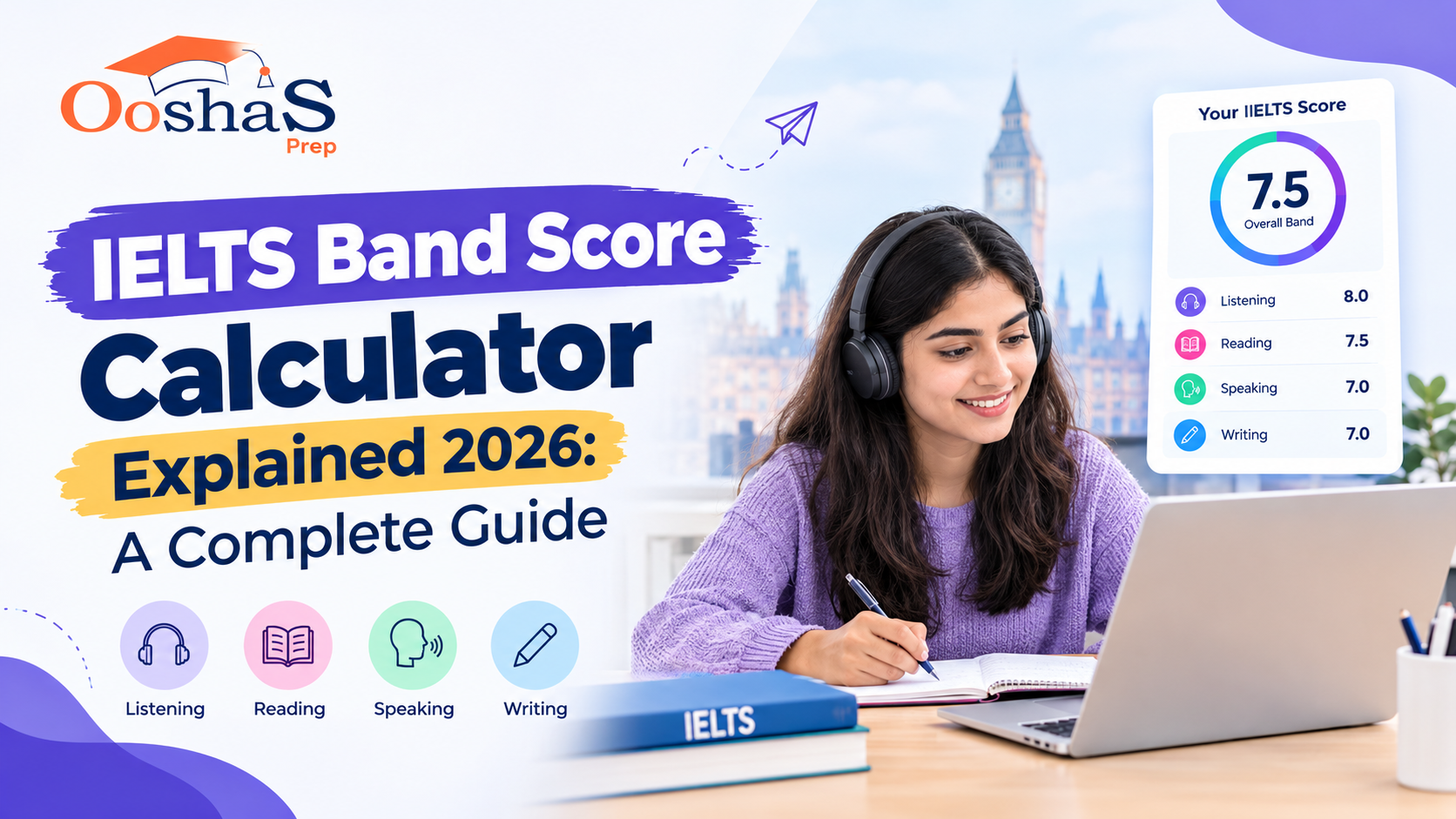
Every year millions of students and working professionals appear for the IELTS exam for studying, working or migrating abroad. After appearing in the exam most of the candidates are unable to decipher their marks and result. An IELTS band score calculator helps you in this regard. This article contains detailed information regarding IELTS scoring system. It offers you an insight into your performance in the examination. Each section has been analyzed separately (exam scores in Listening, Reading, Writing, and Speaking) in order to gain a better understanding of how the scoring in this test works. At the end we have shared the method to calculate your overall band score on the basis of individual scores.
If you are preparing for the exam at home then a band score calculator will help you keep a track of your performance. However, if you want expert advice and professional guidance then it is always a good idea to join an IELTS coaching near you. The best IELTS coaching classes would not only help you to be ready for your exam but would also provide you with the very same band score that you achieved in your IELTS tests. The IELTS coaching classes in Chandigarh would help you understand the scoring pattern.
What is an IELTS Band Score Calculator?
Band score calculator for IELTS is a very easy-to-use device which allows you to translate your actual performance in the test into band scores from 1 to 9. Rather than making an assumption about your band score, you need to enter your right answers or skill level and the calculator will show you immediately what your probable band is. This is because universities, immigration authorities, and organizations worldwide make use of the same 9-point system to evaluate the English skills of candidates. Several students who are enrolled in IELTS coaching in Jaipur and other cities find this calculator useful while preparing for the test.
📊 Already have your raw scores? Plug them into the IELTS Score Calculator above and get your band instantly.
Why do we need the IELTS Band score in 2026?
The majority of universities, employers, and immigration authorities still use the IELTS score as the primary indicator of one’s level of English proficiency. Competitive study programs overseas require an overall band score of 7.0 and no bands below 6.5. Immigration programs like Canada Express Entry give additional points to those with higher IELTS band scores – points that can make you eligible to immigrate faster by years. The jump from 6.5 to 7.0 can provide access to better study programs and jobs. That is why it is so important to understand how the IELTS band score is calculated. This is exactly the goal that most students walking into IELTS coaching in Delhi classrooms are chasing.
Which are the four skills behind your IELTS Score?
Each skill in the IELTS test is graded individually before being averaged; these skills are Listening, Reading, Writing, and Speaking. Listening and Reading use objective, question-based scoring — a computer or examiner simply counts correct answers. Writing and Speaking, on the other hand, depend on trained human examiners who judge your performance against detailed marking criteria. This is why a Writing band score can feel harder to predict than a Listening band score, and why most serious IELTS coaching in Hyderabad programs spend extra hours specifically on these two subjective sections.
How is Listening Band Score calculated?
A total of 40 questions will be asked in the IELTS Listening Band Score Calculation Test. One mark will be given to you for each correct response that you give, and you won’t lose any marks even if you give an incorrect response to any question. The IELTS listening score chart provided below will help calculate your Listening Band Score. This table stays fairly consistent across different test versions, which makes Listening one of the most predictable sections to calculate. Interestingly, the same conversion table applies to both Academic and General Training candidates, unlike the Reading section. Below is the current 2026 conversion table many test centers and prep platforms reference for Listening results.
| Correct Answers (out of 40) | Band Score |
|---|---|
| 39–40 | 9.0 |
| 37–38 | 8.5 |
| 35–36 | 8.0 |
| 32–34 | 7.5 |
| 30–31 | 7.0 |
| 26–29 | 6.5 |
| 23–25 | 6.0 |
| 18–22 | 5.5 |
| 16–17 | 5.0 |
Remember that all you have needed is to answer 30 questions correctly in order to attain a 7.0 band score in Listening. That is, being wrong in 10 questions would not take you out of contention for many universities. Spelling still counts during Listening, so a correctly heard answer with a spelling mistake gets marked wrong regardless of comprehension. Practicing dictation exercises regularly can therefore protect the marks you already earned through good listening skills.
How is the Reading Band Score calculated?
The Reading test also contains 40 questions, and scoring follows a similar raw-to-band conversion process as Listening. However, Reading includes an important twist, because Academic and General Training modules use two different conversion tables. General Training passages read more easily overall, so examiners apply a stricter conversion table to keep results fair and comparable. The passages in academics are inherently difficult, so there is a little extra leniency provided in the marking scheme. The fairness in the system is thus ensured since band 7.0 means the same thing for both modules. Here are the two separate 2026 tables for Academic and General Training Reading results.
Academic Reading Band Score Chart-
| Correct Answers (out of 40) | Band Score |
|---|---|
| 39–40 | 9.0 |
| 37–38 | 8.5 |
| 35–36 | 8.0 |
| 33–34 | 7.5 |
| 30–32 | 7.0 |
| 27–29 | 6.5 |
| 23–26 | 6.0 |
| 19–22 | 5.5 |
| 15–18 | 5.0 |
General Training Reading Band Score Chart-
| Correct Answers (out of 40) | Band Score |
|---|---|
| 40 | 9.0 |
| 39 | 8.5 |
| 37–38 | 8.0 |
| 36 | 7.5 |
| 34–35 | 7.0 |
| 32–33 | 6.5 |
| 30–31 | 6.0 |
| 27–29 | 5.5 |
| 23–26 | 5.0 |
Take note of interesting facts about General Training Test participants who need 34-35 correct responses to achieve a mark of band 7.0, while Academic Test candidates only need 30-32 correct answers for the same band score. This might be surprising for some novice candidates, so it is crucial that checking out the right table according to your exam type. The ability to skim and scan is going to help you find the answers quicker and leave more time for later hard questions.
How is the Writing Band Score calculated?
Writing works completely differently from Listening and Reading, because there are no fixed questions with single correct answers. In fact, two of your written tasks are evaluated according to four different criteria of assessment, each of which has the same importance. The four criteria include task achievement, coherence and cohesion, lexical resource, and grammatical range and accuracy. Each of the four criteria has its own score, ranging from 1 to 9, and the scores are averaged by the examiners.
There are no "right" answers in writing. Your two written tasks are assessed according to four equally important criteria: task achievement, coherence and cohesion, lexical resource, and grammatical range and accuracy. Each gets its own band from 1–9, and the four are averaged into your Writing score. Because this depends entirely on human judgment, most calculators can only estimate this section — feedback from a trainer, or the kind of structured practice you'd get at an IELTS coaching in Bangalore center, remains the most reliable way to pin it down.
How is the Speaking Band Score calculated?
Speaking uses a human assessment system that is similar to the one used when scores come from a written test. However, assessment occurs during a speaking test through either a personal interview or a video interview. While conducting an interview, assessors will rate you based on your performance in four different aspects, During the evaluation interview, evaluators mark four domains of speech: fluency and coherence, lexical resource, grammatical range and accuracy, and of course pronunciation. Fluency is defined as the ability to express ideas smoothly and naturally without any long breaks or too many pauses in between sentences. Just like Writing, your four criteria scores get averaged into one final Speaking band score for that section. One of the best tips for identifying common mistakes is recording your practice sessions and reviewing them honestly afterwards. A lot of candidates overlook how spontaneous and natural answers can improve the overall fluency score in comparison to learned and prepared ones.
How is your overall Band Score calculated?
Upon obtaining the scores from the different sections of the test, the IELTS calculates your overall band score by determining the numerical average of the scores you have received from the four individual components. The result will then be further refined according to the specific rounding mechanism relevant to the 9-band scoring system. If the decimal in your band score is less than the recorded figure of 0.25, then your score is taken as rounded down to the lower full band. If the average decimal falls between 0.25 and 0.74, the final score will fall between the various half bands depending on where the average decimal falls. In the case where the decimal is 0.75 or higher, the round figure score that is obtained will exceed the average score by one complete band.
In order to make things clearer for you on how this rounding process happens, here is an illustration using some numbers. Let us just assume for the sake of the example that your scores are Listening 7.5, Reading 7.0, Writing 6.5, and Speaking 6.0, and your average score comes out to be 6.75 or (7.5 + 7.0 + 6.5 + 6.0)/4, with each number being rounded off. However, since your score is also rounded off, then your overall score will be 7.0. If you had reversed your score in Writing to 6.0 from 6.5, then your scores will be Listening 7.5, Reading 7.0, Writing 6.5, and Speaking 6.0. And once again you have an average score of 7.0.
How to use an IELTS Band Score calculator?
Take a full practice test first. You need to do a practice test first. Before calculating anything, sit through the whole practice Listening/Reading test, under timed conditions. The reason is that any half-hearted attempt will only give you a false number to start from.
Count your correct answers honestly. Go through your answer sheet and mark each response as right or wrong without guessing in your own favor. Keep your Academic and General Training results completely separate, since each module uses its own band score calculator table.
Convert raw marks into a band score. Take your total correct answers out of 40, then match that number against the official conversion table for that skill. Remember that Listening uses one shared table, while Reading splits into two separate tables based on your module.
Estimate your Writing score carefully. Write your own essay within the time limit provided, and then evaluate your essay by yourself according to the criteria discussed above. If possible, let an instructor or a reliable AI tool score your essay, because self-assessment may seem too easy on yourself.
Estimate your Speaking score the same way. Record yourself doing an actual speaking test, and check on your fluency, vocabulary, grammar, and pronunciation using fresh ears. If you compare yourself to band descriptors, then you will be getting a more realistic score.
Enter all four numbers into your calculator. Enter your scores for Listening, Reading, Writing, and Speaking into any IELTS band score calculator that you consider credible. The calculator will automatically calculate your average for all four categories and round the result accordingly.
Review your overall band score result. Pay close attention to the final figure and see if it meets your required level for admission, visa, or immigration purposes. This will give you an exact idea of how far you are from your objective.
Identify your weakest skill immediately. Compare your four individual scores side by side and find whichever skill sits lowest, since this one drags your entire average down. Most candidates discover their Writing or Speaking score needs the most attention.
Build a focused practice plan around that weak skill. Invest more hours each week into that part which is your weakest as opposed to working equally hard at all four parts every week. Working on your weakest point will always yield better results than working generally.
Repeat this process every two weeks. Take practice tests often and determine your overall band score to see how much you have actually improved. This process will ensure that your preparations stay realistic and you will know precisely when you are ready for the actual test.
Can't attend classes in person? Our Online Coaching gives you the same expert feedback — from anywhere, on your schedule.
Which are the common misconceptions about IELTS Band Scores?
You need a Band 9 to succeed. A perfect score of Band 9 is not necessary for admission or visa purposes. Most of the top universities accept a minimum overall score of 6.0-6.5, whereas good courses require 7.0-7.5.
Native English speakers always score Band 9. A person who is a native speaker does not necessarily score 100 percent in his exam. Other factors like organization, vocabulary, grammar, and time management are considered to score good marks in IELTS; therefore, most of the native speakers get a score of 7.5 to 8.5
Band score calculators are 100% accurate. Listening and Reading calculators provide useful estimates, but they cannot guarantee your final score. Small differences between test versions may change your result by up to 0.5 band.
Writing and Speaking calculators are equally reliable. These sections are assessed by trained examiners, making them subjective. Online calculators can only predict your likely score, not your official band.
General Training is easier than Academic. Although the General Training Reading test may seem easier, it uses a stricter band conversion table. You often need more correct answers to achieve the same band score.
A strong skill can offset a weak one. Many universities and immigration authorities require minimum scores in each IELTS section. A low score in one skill may affect your eligibility despite a good overall band.
Retaking IELTS guarantees a higher score. Simply taking the test again does not ensure improvement. Better results come from focused preparation and addressing weak areas.
Band scores always round up. IELTS follows fixed rounding rules. Rounding up your grade only takes place if your average attains the required standard.
Get complete IELTS Exam Details Information — pattern, duration, scoring, and eligibility — all in one place.
Conclusion
Understanding how your IELTS band score is calculated demystifies the test. Listening and Reading scores are based on table values, whereas Writing and Speaking require human evaluation. Whether you are preparing for IELTS on your own or with IELTS Coaching in Pune, Bangalore, Hyderabad, Chandigarh, Delhi, Chennai, Jaipur or opting for PTE, a band score calculator (or a PTE score calculator, for the PTE takers) will help you know your current level and set weekly targets.
Frequently Asked Questions
The IELTS Band Score Calculator calculates your IELTS band score by considering your scores in Listening, Reading, Writing, and Speaking.
While the calculator gives an accurate prediction, only certified IELTS examiners and IELTS marking criteria will grade your IELTS test.
No, it is not possible to know your results prior to taking the exam.
Yes. But there is a difference in Listening and Reading score conversions in the two types of tests.
No. These sections are graded by trained graders, and so online calculators can give you only approximate scores.
It is the average of the scores for each of the four sections, rounded using IELTS band score rules.
No. The scores are rounded only if they satisfy the IELTS rounding off rules.
the most common acceptable band score range accepted by universities is 6.0 to 7.5, depending upon the program and institution.
Yes, but your improvement will depend upon whether you prepare well or not.
Yes. Most IELTS Band Score Calculators online are free to use.