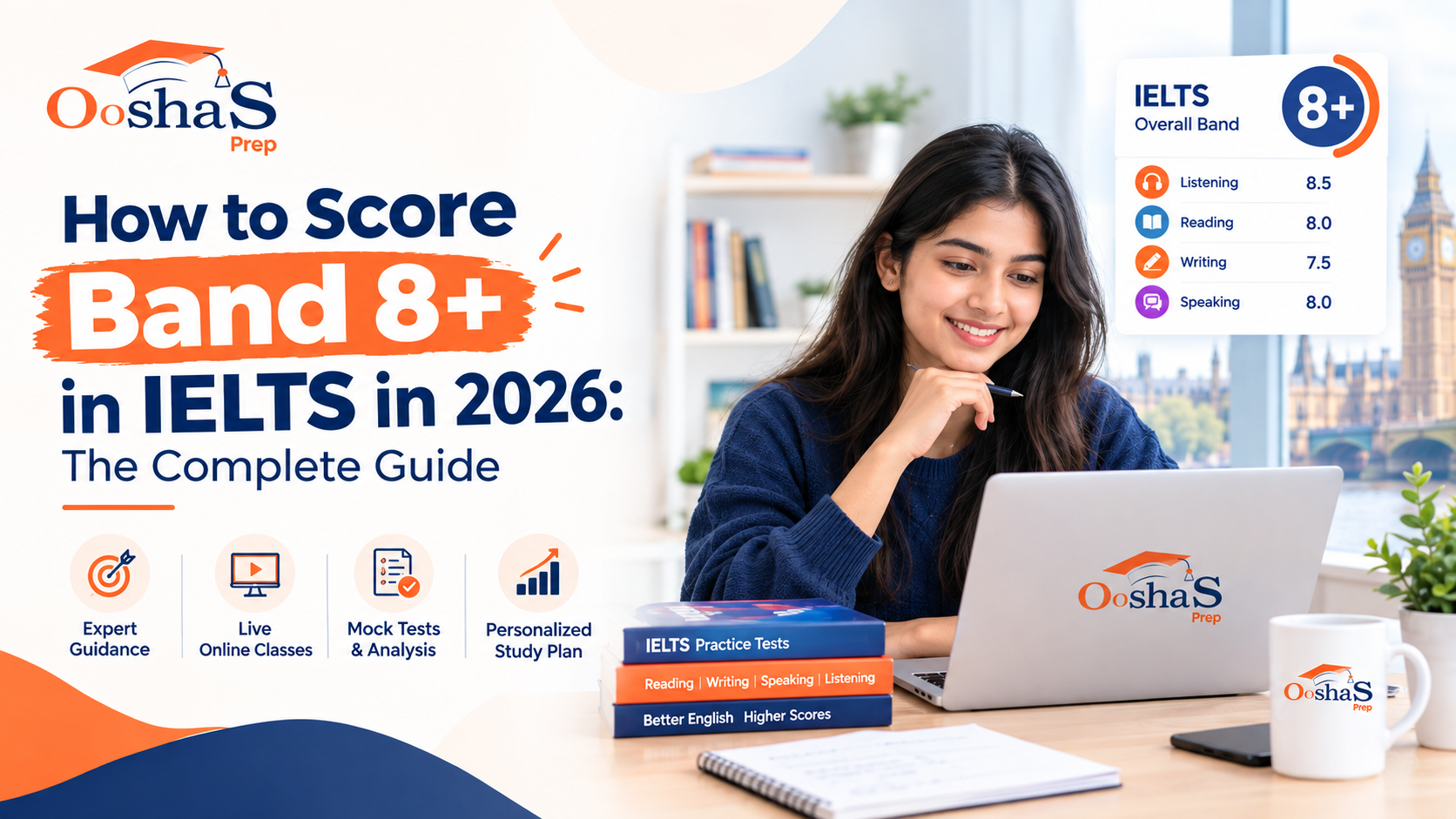
How to Score Band 8+ in IELTS in 2026: The Complete Guide
Scoring a band 8 in IELTS is often considered by many a distant goal. However, if you know how to prepare it can be achieved by thousands of students per year. The IELTS 2026 exam contains some changes to previous versions and understanding them can significantly benefit you over other students who are still using old material. In this article, you will find information about all parts of the test, what the examiners are looking for, and what tactics can benefit you in the new IELTS test version.
Whether you are planning to study abroad and need to fulfill the language entry requirement, or want to apply for skilled migration, and even if you only want to assess your English level, this article will benefit you. We will discuss all four IELTS sections in detail and reveal what daily practice can differentiate you from the others and help you score a band 8 or higher.
Understanding the IELTS 2026 exam format before you begin
To move on to any other preparation for IELTS tests, you first need to be aware of the modifications in the test structure. The IELTS test centers are gradually abandoning the paper-based exam and embracing computer-assisted tests in 2026 throughout most of the global market. A hybrid option of Writing on Paper remains available in a minority of English-speaking countries, as an alternative for candidates not comfortable with technology. The duration of the IELTS exam has not changed either and still stands at two hours and forty-five minutes. The Listening and Reading tests will each last thirty and sixty minutes respectively. The Writing test will take sixty minutes whereas the Speaking test takes eleven to fourteen minutes.
The changes witnessed in the 2026 examination schedule are found in the One Skill Retake (OSR) policy. With OSR, if you have a good score in three bands but a poor result in one band, you do not need to resit the IELTS because you will be allowed to repeat the module you scored low on and submit a new score report. If you sit for the IELTS on Computer, you may repeat a skill you scored low on within sixty days of your initial examination. Secondly, there has been a change in marker expectations, and IELTS examiners are now ready to punish candidates who resort to using memorized essays. All those who come up with a template essay or response will be punished.
In IELTS exam, the listening part comes first, then reading, writing, and finally speaking. While doing IELTS exam using computer, there are four parts in IELTS exam that are listening, reading, writing, and speaking. But when taking the test on paper, one encounters listening, reading, writing before speaking.
In IELTS exam, the listening part comes first, then reading, writing, and finally speaking. While doing IELTS exam using computer, there are four parts in IELTS exam that are listening, reading, writing, and speaking. But when taking the test on paper, one encounters listening, reading, writing before speaking.
What does Band 8+ actually require?
- The Real Meaning of a "Very Good User"- Band 8 sits in the "very good user" category, and it demands more than strong vocabulary or accurate grammar. Examiners expect fully operational command of the language, with only occasional inaccuracies and rare misunderstandings in unfamiliar situations. Reaching this level requires consistency across all four skills, since a weak score in even one section pulls your overall average down significantly.
- Why coherence and cohesion matter more than fancy words: Many candidates assume that big words and complicated sentence structures automatically impress examiners, but this assumption often backfires. The 2026 scoring guidelines place stronger emphasis on coherence and cohesion, meaning your ideas must connect logically rather than sound impressive in isolation. Clarity now carries more weight than complexity that gets used incorrectly, so simple, accurate English often scores higher than forced sophistication.
- Communicate clearly instead of sounding complicated- Your goal, therefore, is not to sound like a walking dictionary. Instead, aim to communicate your ideas clearly, support them with relevant examples, and organize your thoughts so a reader or listener follows your logic effortlessly. This mindset shift alone improves scores for thousands of candidates every year.
How can you master the IELTS Listening Section for a Band 8+ Score?
While the IELTS Listening test keeps its 40 questions in 30 minutes layout, it begins to adopt a more realistic approach in 2026. order of sections is less predictable, recordings contain a wider range of accents (Indian, Nigerian, Australian, and British among others) and include more background noises that one would encounter in real-life professional or academic settings.
Listening tasks have become more difficult for candidates who employ the strategy of ‘keyword matching’. To achieve an 8 or higher, test-takers must demonstrate a higher level of listening comprehension as opposed to simply highlighting keywords that have been underlined or circled in the text. Paying attention to paraphrasing is essential as the listening script rarely uses the same wording as the one in the text.
Practical steps that one can take to improve listening scores:
- Practice with real conversations and lectures in English, not by the test-like recordings because it will make one familiar with different accents. One is unlikely to hear the same pronunciation of words from two native English speakers.
- A person should listen to recordings just once during practice, as one has to do during the actual test.
- It is better to use books with practice tests from IELTS Cambridge because they have the most relevant materials with similar accents and question types as in 2026.
- Shadowing training will greatly improve listening skills since it helps to ingrain the patterns of pronunciation from native English speakers.
- When listening tests are done, one has to analyze the wrong answers and define whether the mistake was due to the insufficient vocabulary or inattentive listening.
How can you crack the IELTS Reading Section with proven strategies that work in 2026?
This year, IELTS Reading has become harder because there are many matching questions that take up a lot of time. In addition to that, the reading passages have become longer, and the questions have required more inference. Therefore, it is now essential to learn how to read thoroughly and quickly and understand the general idea and specific information.
This will help only when enough time is spent on scanning the text in order to understand its main idea rather than looking for certain words. In addition to that, one should know how to scan the text in order to locate the place where the answer is located. These two skills are vital to complete all the passages during the allocated 60 minutes.
here are various methods that can help you improve your reading score:
- try to read the questions first and look for the required information in the passage while skimming it,practice the types of questions given in the test, as they take the most time: matching headings and matching information,
- remember to underline the keywords in the questions and try to find their synonyms in the passage,
- train yourself to work within the given time limits: do not spend more than 20 minutes per passage to leave enough time for the last one,
- enrich your vocabulary by reading newspapers, magazines, and articles on different topics.
Templated answers won't get you to Band 8 in 2026 — personalized feedback will. Join a live online batch and fix your weak sections faster.
How can you master IELTS Writing Task 1 and Task 2 to achieve a Band 8+ Score?
IELTS Writing is the part where most often people lose points. It is because nowadays, examiners consider such factors as coherence and originality of ideas much closer. The essay written from a template and introduction will be penalized in 2026, as examiners are trained to detect such cases, and the two first mentioned criteria will be marked lower regardless of grammatical accuracy.
Task 1: Reporting Data Clearly
Task 1 demands for summarizing the presented visual data, be it a graph, chart, table or any other form. However, in 2026, it is more likely that the examiners will combine the types of charts in one task, for instance, a bar chart and a line graph. In addition, you may also see a table with multiple variables or a process with diverging branches, not a simple chain.
The crucial thing while describing a visual presentation is avoiding an attempt to include all the details in the description. Instead, you should single out the most prominent trends and changes and make comparisons between the data. Moreover, remember to follow the particular structure and maintain a certain number of paragraphs, including an introduction, an overview paragraph and two body paragraphs.
Task 2: Building a Strong Argument
The prompts for the task 2 essays have become significantly more sophisticated this year. The usual prompts asking whether one agrees or disagrees with something are becoming less frequent. Instead, the task 2 prompts are asking more analytical questions like how the overreliance on AI tools in the classroom limits a student's cognitive aptitude.
Follow this approach to build strong Task 2 responses:
Spend the first five minutes planning your essay structure and main ideas before writing a single sentence.
Address every part of the question directly, since partial responses receive lower task response scores even with excellent language.
Support each main idea with specific, relevant examples rather than vague generalizations that examiners have read hundreds of times before.
Use a variety of cohesive devices in your writing, and avoid using the same 3 words to start a new paragraph.
Take the time to always spare 5 minutes at the end of your writing for proofreading your essay for any grammatical and spelling mistakes.
Issues such as AI security, data privacy, telecommuting, and green energy are becoming more prevalent in modern-day prompts; therefore, it is vital to be up to date on recent developments. That is why students who read newspapers regularly have a better chance of doing well than those who memorize vocabulary lists. You should try to write between 270-290 words, because many candidates who write less get penalized, while those who write too much usually end up making foolish mistakes.
How can you sound natural instead of rehearsed in the IELTS Speaking Section?
Nevertheless, the IELTS speaking exam of 2026 is still conducted in three parts which include the introduction part, the long-turn question card description, and the discussion. At the same time, the availability of the video conferencing test facility has increased for test centers across the world. The marking criteria of the test have remained the same in either case, hence you should not prepare differently for any of them. In addition, you have the freedom to practice both as long as the test center offers that chance.
However, the IELTS Speaking questions of 2026 are realistic and ask for spontaneous answers. Answering questions through memorized answers for generic questions will not help much and could end up causing you to lose points due to appearing to be robotic. Additionally, an experienced examiner is able to pick a memorized answer almost immediately. Therefore, as you prepare for the test in 2026, you should try and remove the bad practice of reading scripts.
Use these strategies to improve your speaking score:
- Try to practice speaking in English, even if you are alone, so that you feel more confident when speaking to another person.
- Record yourself and focus on using appropriate filler words and not making weird pauses or pronunciation errors
- Speak in groups or in pairs because speaking alone will never help in improving your conversation skills.
- Improve your vocabulary for various subjects such that you will not be taken by surprise when required to speak impromptu.
- Learn how to emphasize on words through correct intonation rather than trying to develop an accent which is alien to you.
Remember that the examiners will reward fluid and natural sounding English even if it isn't perfect in terms of grammar or vocabulary. Speaking hesitantly with lots of pauses to gather your thoughts will leave a bad impression on the graders.
New OSR policy, revised scoring, computer-delivered format — the 2026 exam has changed. Get the full breakdown before you book your test
Which strategy should you opt for to achieve an IELTS Band 8+ Score?
Consistent daily practice is more important than occasional periods of intensive preparation before the test day. Successful candidates say they spend about two or three hours each day studying all four skills, distributing their time between the different areas. They advise against spending all your time on your favorite section. It may be tempting to ignore the area in which you are weakest, but that will probably prove a costly mistake. However, instead of trying to memorize answers, it is vital to use a method which allows you to be accurate in all sections.
- Get yourself acquainted with the IELTS exam pattern - work your way through all four sections (Listening, Reading, Writing, and Speaking) in order to familiarize yourself with their respective format, marking system, and duration.
- Develop a practical study schedule- allocate a certain amount of time per day to studying English, and divide this time between the four IELTS sections. Two to three hours a day devoted to learning are enough. Do not try to cram for the test – consistency is more important than intensity in language learning.
- Improve your English language skills- the more proficient you are in English language, the more IELTS band score you will obtain. Read English newspapers and English books, listen to the English news, practice your writing skills and speak English whenever you can. The more you know about the language, the more material you will be able to use for retelling and discussing.
- Test preparation should be done by using official practice materials – practice tests will show your strong and weak points and areas that need to be improved. Focus on learning from your mistakes rather than the final score.
- Learn to manage your time during the test- poor time management is one of the main reasons why test-takers perform below their level. Do not get stuck trying to figure out one question – move on and return to it later.
- Develop individualized strategies for each module:
- Listening: Read the questions prior to listening and concentrate on keywords.
- Reading: Develop skimming and scanning techniques to find the answers.
- Writing: Plan your answer first and then write it using appropriate examples.
- Develop an extensive vocabulary and know how to use it properly. You should not try to learn vocabulary by memorizing words from a list; instead, you should learn vocabulary through practice. This entails lots of reading and using the new words in your writing and speech. You should learn how to use vocabulary appropriately instead of using fancy words without meaning.
- Get regular feedback — have your Writing and Speaking responses reviewed by an experienced trainer or mentor. Structured programs like IELTS coaching in Bangalore, offer this kind of personalized correction that's hard to replicate alone.
- Take mock tests. You need to practice sitting the test in timed conditions. Mock tests will help you to build up your stamina, so that you can sit for almost 3 hours with little rest in between.
What are the most common mistakes that prevent you from achieving an IELTS Band 8+ Score?
Scoring Band 8+ in IELTS requires strong English skills and the right preparation strategy. Many candidates lose marks because of simple but avoidable mistakes.
- Ignoring the format- not understanding the test pattern and scoring criteria can lead to unnecessary errors. Learn the format of all four modules before you begin preparing.
- Poor time management- Spending too much time on one question leads to leaving others blank. Practice tests will help you develop a good sense of timing.
- Memorized responses- Using answers you have memorized for the Speaking and Writing test will not produce natural language. Always speak and write using your own words and examples.
- Weak vocabulary- Advanced words are not always appropriate words. Use appropriate vocabulary correctly and naturally.
- Grammar errors- Errors of Grammar, Usage, or Mechanics found frequently throughout your test responses can bring down your score. Practice and review your grammar skills
- Lack of practice- It is important that you do not study only theory. Taking full-length practice tests will allow you to increase your confidence and identify areas of weakness..
- Skipping feedback- Many candidates never review their mistakes. Getting feedback on your Writing and Speaking tasks helps you improve faster.
Choosing the Right Practice Resources in 2026-
However, not all the study material will be representative of the current test, and thus the choice of the most recent sources is crucial. Speaking about the preparation of the test in 2026, it may be wise to pay attention to the official sources of the Cambridge IELTS books since they have the most appropriate questions and transcripts.
For example, reading newspaper articles in English is an activity that will allow you to develop your receptive skills constantly. following news outlets’ opinion pieces can also be useful for the IELTS Writing and Speaking parts.
Ideally, it is recommended to consult an expert IELTS tutor or take up a course designed specifically for this purpose. This becomes even more relevant considering the fact that training under the guidance of an expert teacher can help gain some invaluable insights which cannot be obtained by self study. The point becomes highly relevant for the IELTS Writing and Speaking skills, since they are more subjective in nature.
Final Thoughts
Aiming for Band 8+ in IELTS in 2026 is an ambitious goal but one that has to be taken on with determination and hard work. There is more to scoring highly in the IELTS test than learning a few useful sentence structures. In fact, the new exam patterns have changed considerably and now assess students on their actual knowledge of the language. Students should concentrate on improving their overall knowledge of the English language, rather than neglecting their weaker areas.
Utilize the new sources, record your performance, and make sure you are doing your best in all the practice sessions. In light of the new rule of One Skill Retake, you do not need to worry even if you have a bad day in any of the modules. Nevertheless, you must always do your best while preparing for the exam. You should not give up on your dream of scoring a Band 8+. With hard work and dedication, you will be able to reach your desired goals.
Frequently Asked Questions
It means an excellent command of the language with a rare number of errors.
It can be achieved with the right guidance and practice.
Most candidates practice 2 – 3 hours a day for weeks or even months to achieve this score in either IELTS modules.
Yes, you can achieve the score of 8+ on your first try if you prepare yourself efficiently.
Writing is the trickiest part to score a band 8, according to the candidates.
Yes, using the appropriate and high-level vocabulary in your answers matters a lot when you are scoring 8+.
Yes, mock tests help you prepare for the test environment and enhance your time management skills.
If you commit too many grammar mistakes, you might not score 8+ in your IELTS exam.
No, speaking cue cards do not allow rote-learned answers, so avoid them and speak fluently and naturally.
You need to prepare a proper study plan for IELTS 2026, practice daily, and enhance your weak areas.