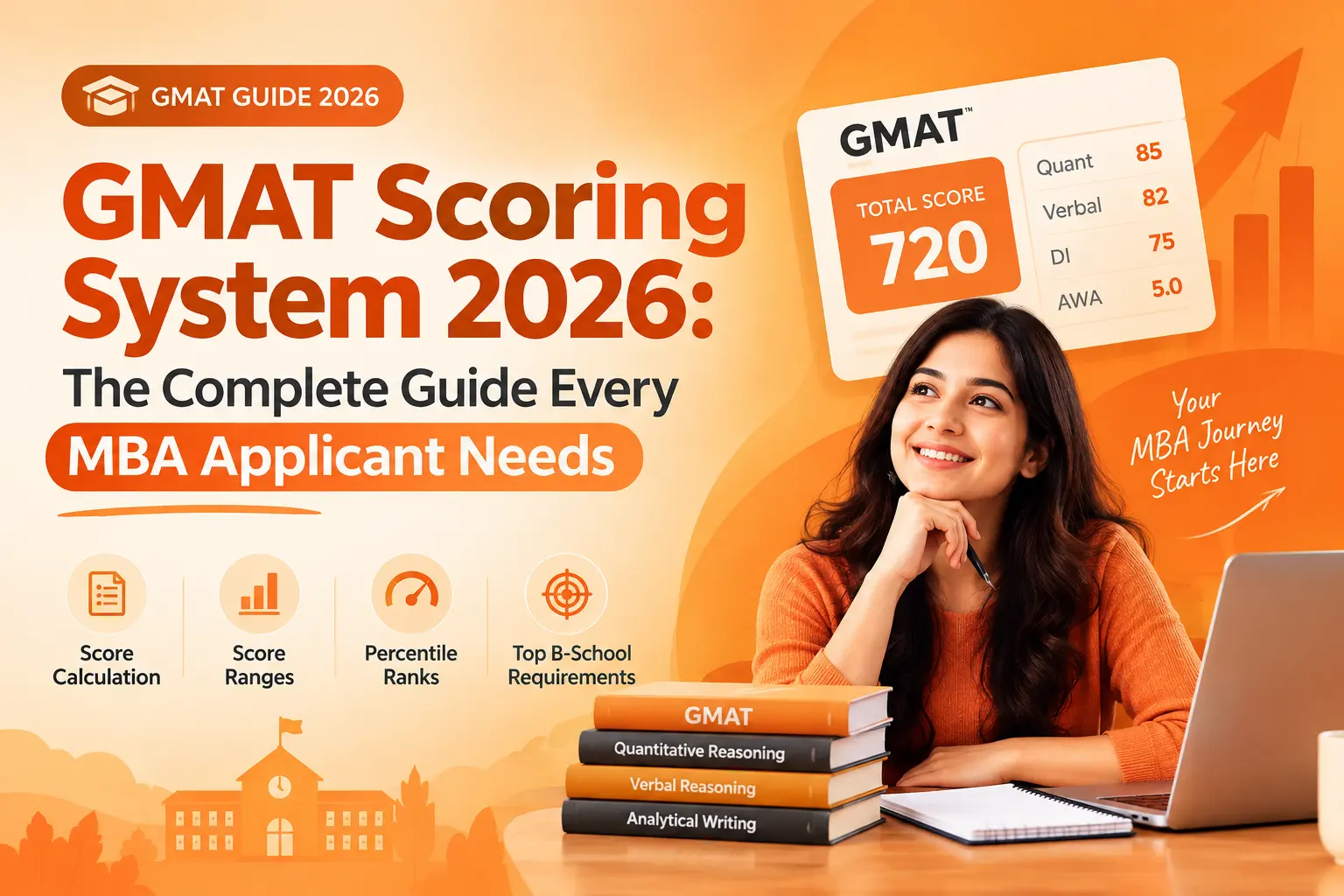
To crack GMAT in 2026 is a complex task. Unlike previous years, the exam, competition, and scoring rules have changed significantly, which makes it even harder to get an A-grade result on the GMAT. Therefore, if you are now sitting in front of your laptop, lost in different ideas about where to begin your preparation, do not worry. In this article, you will find useful information that can become a guide to your GMAT success.
What should we know about GMAT Focus Edition before we prepare?
GMAT Focus Edition: The GMAT Focus Edition is the replacement of the classic GMAT which was introduced in late 2023 and is the current form of the test through 2026.
- Three sections: The GMAT Focus Edition consists of three sections including Verbal Reasoning, Quantitative Reasoning and Data Insights.
- Exam length: Each part of the exam lasts 45 minutes and has 64 questions. Therefore, it takes approximately 2 hours and 15 minutes to complete the test.
- Shorter exam: The new exam version is shorter than the previous one by around 45 minutes. As a result, it is more compact and relevant.
- No analytical writing: Unlike the older version of the exam, the GMAT Focus Edition does not include the Analytical Writing section.
- No sentence correction: GMAT Focus Edition does not have a Sentence Correction component any longer.
- Data insights: One of the significant elements of the exam is Data Insights, which combines data analysis and reasoning abilities. It also includes questions about sufficiency of data and contributes one-third of the total score.
- For students: The most crucial tip for those students who are preparing for the exam is that the current test differs greatly from its earlier version.
How does GMAT Scoring work in 2026?
- Total Score Range: GMAT total score falls between 205 and 805 with each interval being 10.
- Equal Section Weightage: Each score in GMAT is weighted equally.
- The sections which constitute the GMAT are quantitative reasoning, verbal reasoning, and data insights.
- Each GMAT section score (QR, VR and DI) falls between 60 and 90.
- GMAT Score before 2026: There was a different GMAT scoring before 2026. Previously, QR and VR was scored up to 51 while IR and AWA used to have their own scoring system.
- Good GMAT Score: A good GMAT score is achieved when one attains 645 marks and above which is said to be 88th percentile and above.
- Good GMAT Score for Top Colleges: This implies that a good GMAT score for top colleges is 695 and above which is 98th percentile and above.
- Good GMAT Score for M7: A good GMAT score for M7 ranges between 700-750 in line with the 2026 expectations.
- Good GMAT Score for T25: A good GMAT score for T25 ranges between 650-700.
- Good GMAT Score Tips: The tips of a good GMAT score should not be a reason to panic. If one is able to work on the weak areas, nothing can stop them from achieving their dream score.
Registration Costs and Retake Rules in 2026
- Before you begin your studies, become familiar with the details that come with taking the test. The registration fee costs $275 if you test at a physical center, or $300 for the online version.
- As for the retake rules, the restrictions have been lifted a bit recently; you need to wait 16 days between attempts, and you are allowed to take the GMAT up to five times per year, within the same 12-month period.
- GMAC also lifted the lifetime ban of eight attempts, which was in place until October of this year (2024), which means the number of allowed tests is no longer limited to eight throughout your lifetime. That being said, you should not take this lightly, as every retake will require you to spend money, time, and effort.
- In case you already have an old GMAT score, do not panic because many business schools accept old GMAT scores for the year 2026. It is just that you need to confirm the requirements with the business school you choose to join. complete GMAT Score Calculator preparation guide
What are the key steps to prepare for the GMAT in 2026?
Step One: Take a Diagnostic Test First
Prior to getting into the preparations for the GMAT, it is necessary to assess the present stage of knowledge and proficiency. The taking of the diagnostic test will be useful for keeping an account of the progress and having a proper understanding of the areas that require improvement. It is critical to invest at least two hours in the test and find the most comfortable place for you. After the diagnostic test GMAT, you will get your results which tell you how well prepared you are for each section of the test. By studying them in detail, you will be able to know which points need improvement.
Many companies provide a free diagnostic test with an in-depth analysis of the results, pointing out problem areas, optimal learning strategies, and opportunities for improvement. It will help you identify which areas of the GMAT require more attention and preparation.
Step Two: Set a Realistic Target Score
Before moving on to the next step, you need to set a realistic target score. The target score should be determined based on the average marks of the business schools you are interested in and your competitive edge in the academic field.
While defining your target score, you should not set a very high grade that seems impossible to reach in a short time. Thus, while calculating the training time for the GMAT exam, you should take into account your diagnostic test results, target score, academic background and the amount of time you can spend on training.
Estimate Your GMAT Score in 60 Seconds
Free GMAT Score Calculator — Estimate Your Percentile Instantly
Step Three: Creating a Weekly Study Schedule for the GMAT
In creating your weekly preparation schedule for the GMAT, you want to be realistic as to how much time you actually have. If you are working full-time, studying for the GMAT for a few hours per workday may not be practical. Perhaps an hour of concentrated study each weekday and two or three hours on the weekend would be a good schedule.
The sections you need to prepare for are Quantitative Reasoning, Verbal Reasoning, and Data Insights. However, do not spend more than a week or two preparing for one section before moving on to the next. The most important thing is to practice in 45-minute segments, as you will be taking the GMAT in this time frame as opposed to the old GMAT format.
Your Complete Guide to the GMAT Exam
From registration to result day — get the full picture before you begin your prep.
Step Four: Master the Quantitative Reasoning Section
Quantitative Reasoning is all about math, including arithmetic, algebra, and some data analysis. First, you need to go over the fundamentals, including percentages, ratios, factors, equations, and more. Then, you should practice quantitative problems in general and time yourself to simulate real conditions. You may want to avoid hard questions at first and focus on easier ones to build your confidence.
GMAT is not just about math – it is about logical thinking and getting to the right answer in a limited time. That is why practice is so important, and you should start early instead of cramming in the last weeks before the test. Moreover, you need to analyze your mistakes to see what you did wrong a conceptual mistake, a computational one, or a lack of time. Finally, you need to learn Data Sufficiency to ace the Data Insights section. These two parts are similar, so you need to master them both.
Step Five: Enhance Your Verbal Reasoning Proficiency
The verbal reasoning test in its present format stresses on critical reasoning and reading comprehension, whereas sentence correction has been totally removed from the test pattern. Work on your reading skills by reading business articles, op-eds, journals, and any other informational document you can find.
The goal is to improve your reading speed and, more importantly, your ability to glean the most useful information. Concentrate on the main idea, the arguments, and the supporting information, ignoring the rest. And for critical reasoning, practice finding the conclusion and the evidence that supports it before looking at the answer choices.
Step Six: Get Comfortable with Data Insights Early On
You need to get comfortable with data insights early on in your preparation. Data insights consist of Data Sufficiency, Multi-Source Reasoning, Table Analysis, Graphics Interpretation, and Two-Part Analysis.
In order to learn how to solve these questions effectively, one has to be able to identify the difference between them and what they are asking for. Table analysis is about sorting and filtering, graphics interpretation is about reading charts, multi-source reasoning is about connecting different pieces of information, and two-part analysis is about understanding the relationship between two variables.
While it might seem similar to quantitative reasoning, you need to treat it as a separate subject. Data insight questions require mathematical aptitude, logic, and some reading comprehension to get the most out of the information given to you.
Step Seven: Take Full-Length Practice Tests Often
Working through questions each day will hone your skills, but full-length practice tests allow you to see how your skills may come together on test day. Take at least three to four of these tests before your real GMAT.
Take these tests to monitor your scores, speed, accuracy, and endurance. It is also possible for the GMAT test takers to determine the order of taking the sections, which means that you have to try different types of questions when attempting practice. After each practice test, you have to make sure that you spend sufficient time on analyzing your mistakes in order to comprehend the process of finding the right answer.
Step Eight: Make Smart Use of the Review and Edit Function
The current GMAT gives you a review and edit function so that you can go back to questions and change your answers. You are allowed to change three answers per section.
Practice this by taking full-length practice tests and learning how much time you should spend going over changed answers. If you have enough time, you should go through all the changed questions and only amend an answer if you are certain of your thoughts.
Step Nine: Choose the Right Materials for Study
It is vital to choose the preparation resources according to the current requirements of the upcoming exam. The previous books and guides that may have been relevant for the GMAT many years ago are no longer applicable nowadays, as they include the information that has been changed or canceled.
Therefore, the best place to start preparing for the test is to use the official resources with the sample questions matching the upcoming exams. It is also advisable not to use more than one or two different preparation platforms when studying. Doing so may only confuse the student, as different guides or digital tools may organize information differently. Additionally, if the selected material offers an option to review the given answer and its explanation, take it in order to assess the weak spots in your knowledge.
Step Ten: Prepare Your Mindset for the Challenge
When most people think about preparing for the GMAT, they focus primarily on the content of the exam. However, the test taker should also train their mind in order to avoid getting fatigued too early during the challenge.
The current GMAT contains three sections, each of which has to be completed in one hour and fifteen minutes. Without the essay section being taken out of the picture, it is easy to see how one may struggle with the exam. If you know that you have problems concentrating during the work that requires a long period of attention, it would be wise to practice shortened versions of the GMAT sections.
If you need to have proper sleep before the GMAT, do not deprive yourself of it for the sake of cramming for the exam or spending too much time studying. Insufficient sleep leads to inability to concentrate, and therefore to errors during the GMAT test. You can be sure that with a healthy sleep schedule and an effective study plan, your body and mind will be prepared for the exam.
What common mistakes should you avoid during GMAT Preparation?
- Skipping the Diagnostic Test: Do not attempt any GMAT preparation before checking out your current level, areas of improvement, and strengths and weaknesses.
- Setting an Unrealistic Target: Setting a target score that is too high depending on one’s current level, desired business schools, and time allocated for preparation.
- Following an Unrealistic Schedule: Avoid developing a schedule that will not allow enough flexibility and leaves no room for personal life, college, or work.
- Ignoring Data Insights: Do not leave the Data Insights and question types for later; rather begin practicing from the start.
- Using Outdated Study Material: Avoid studying from traditional GMAT resources since they mostly comprise deleted question types, such as the Sentence Correction and Analytical Writing topics.
- Practicing Questions without Timing: It is important to time the practice questions to avoid developing bad habits of leaving extra marks.
- Focus only on the Challenging Areas: It is essential to first understand the fundamentals before you try to solve tough questions. Moreover, it is important to focus on the accuracy and consistency rather than only focusing on the challenging ones.
- Neglecting Mistake Analysis: Avoid focusing only on the correct answer even if you have made a mistake, instead, you need to analyze what has gone wrong and how you can avoid such mistakes in the future.
- Taking Inadequate Number of Full-Length Mock Tests: It is essential to time yourself while taking a mock test to get a sense of timing and the difficulty level of the questions on the day of the examination.
- Overusing Study Material: The use of various resources may be overwhelming; instead, a couple of appropriate sources should be utilized.
- Second Guessing: The review and edit stage is meant to be used sparingly.
- Mental Endurance and Insufficient Sleep: Lack of sleep and extended periods of studying without taking a break can affect a student’s performance during an exam.
GMAT Coaching in India: Do You Need Expert Guidance?
Self-study suits well organized students, but most of the GMAT Coaching in India prefer coaching to hold themselves accountable and save time understanding the new format of the Focus Edition. For those who are not sure whether to choose self-study or coaching, this section will tell you how coaching could be part of your preparation in 2026.
Explore GMAT Coaching in India
India's Trusted GMAT Coaching — Personalized. Proven. Result-Driven.
Why Consider GMAT Coaching?
- Structured study plans tailored to your diagnostic test results and target score
- Expert doubt-solving, especially for tricky Data Insights question types like Multi-Source Reasoning and Data Sufficiency
- Regular mock tests with detailed performance analysis, so you're not just guessing where you stand
- Peer accountability, which helps maintain the consistent, long-term study schedule outlined in Step Three above
Updated materials aligned with the current GMAT Focus Edition — a common gap when relying on outdated books, as mentioned in our common mistakes section
Conclusion
The 2026 GMAT test needs to be prepared with smarter preparation to avoid wasting time and regular practice to gain in-depth knowledge of the concepts regularly rather than studying for long hours. Firstly, take a diagnostic test to set your baseline level and the target score. Set a weekly preparation schedule based on your requirements and preferences, then invest equal time in the Quantitative Reasoning, Verbal Reasoning, and Data Insights sections. Practice each section for an equal time constraint of 45 minutes. In addition, analyse your mistakes and learn from them by taking full-length practice tests. It will also help improve accuracy and test-taking skills and become familiar with actual exam conditions.
Moreover, it will be essential to use up-to-date GMAT preparation materials that will help identify and work on areas of improvement. Lastly, try to utilize the review and edit option wisely to avoid mistakes Moreover, most importantly, ensure proper sleep and break time between study sessions. These test-taking strategies will enable proper learning and retention of concepts without spending long study hours. With regular practice and effective preparation, one can achieve the desired score.
Frequently Asked Questions
Take a diagnostic test to identify your strong and weak areas and the approximate level of your score.
For most test-takers, two to four months is a good time to prepare for the GMAT.
About an hour of concentrated study during weekdays and extended hours during weekends is a good time for preparation.
Depends on the diagnostic test, but Data Insights needs regular practice.
Yes, you need to practice questions with a watch to develop a sense of timing and smartness to answer GMAT questions.
You have to work on your areas of improvement, practice consistently, learn from your mistakes and take regular mock tests.
Data Insights is a critical component of GMAT, so you must practice it regularly.
You should not study too much the day before the exam. Go through important strategies to refresh your concepts and help you remember everything that you have studied while preparing for the exam. Also, make sure to carry all the necessary documents with you and get a good night's sleep.